



Featured Snippet:
أكملت شركة «هايلايت» تركيب وتشغيل منصة اختبار صمامات الأمان ذات التحكم الحاسوبي في جيانيانغ، والتي توفر التحكم الحاسوبي في الضغط، وجمع بيانات الاختبار، ودعم معايرة صمامات الأمان، بالإضافة إلى سير عمل أكثر كفاءة لاختبار الصمامات.
For industrial plants, valve maintenance centers, inspection organizations, and safety valve service companies, purchasing a safety valve test bench is only part of the project. Correct installation, pressure-system commissioning, control-system configuration, and verification of the complete testing workflow are equally important before the equipment enters routine service.
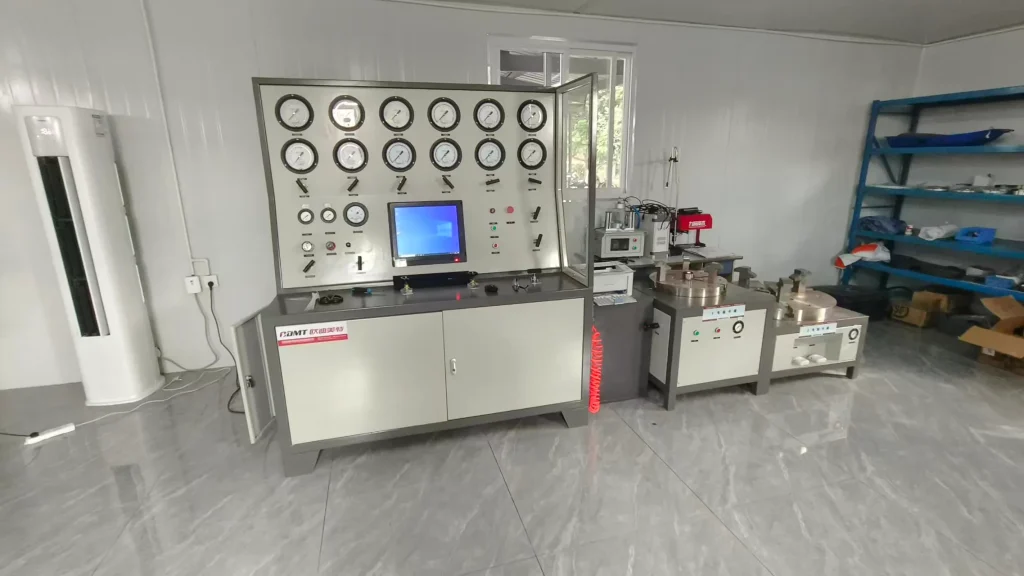
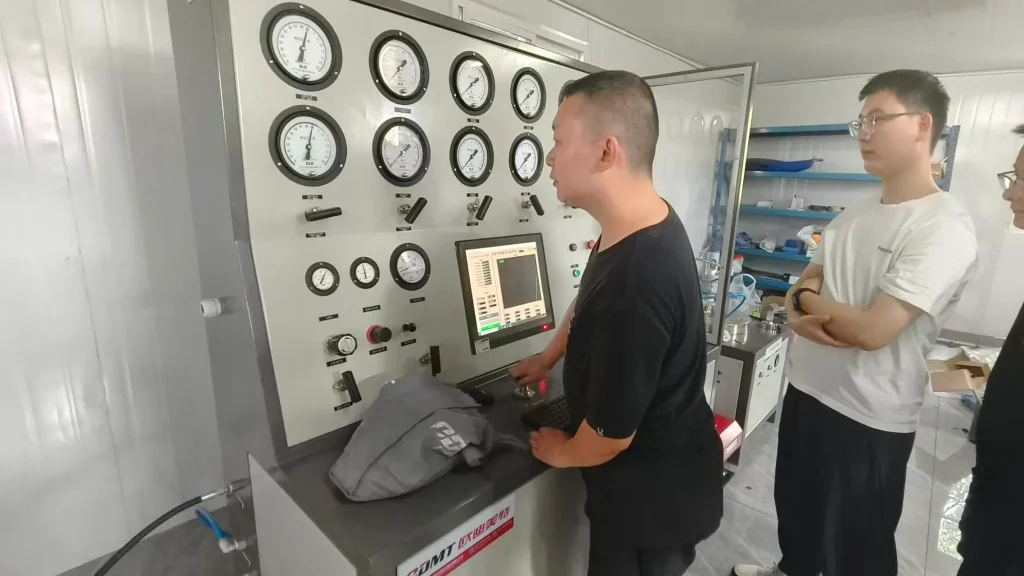
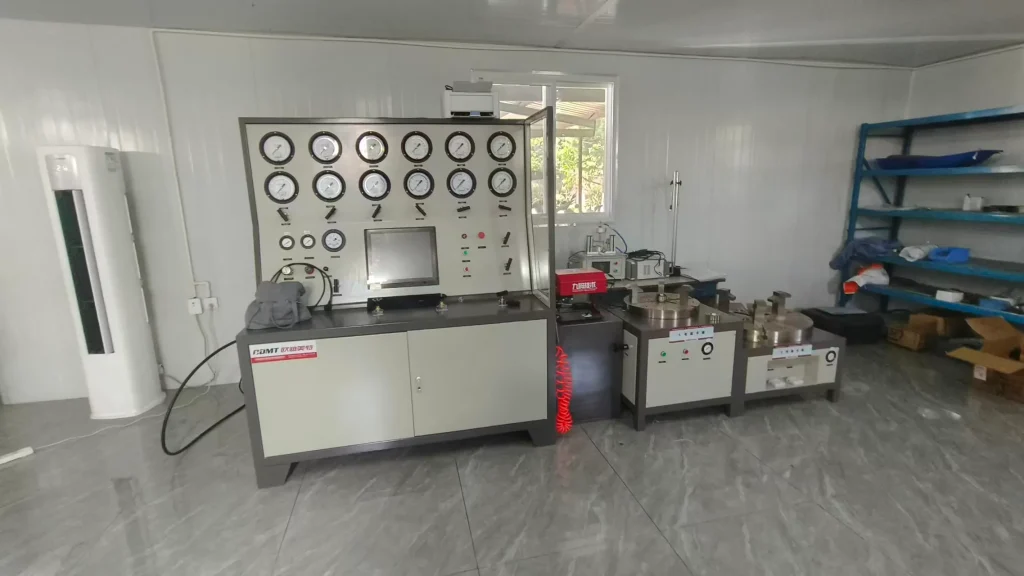
Highlight recently completed the installation and commissioning of a Computer Control Safety Valve Test Bench in Jianyang, China.
Unlike a traditional manual control safety valve test bench, this project uses computer-based control and data acquisition to support a more digitalized valve testing process. The solution is designed around controlled pressurization, pressure measurement, safety valve testing, data recording, and test management.
For buyers comparing a منضدة اختبار صمام أمان التحكم بالكمبيوتر, automatic safety valve test bench, PSV test bench, or customized valve test bench, the Jianyang project demonstrates how the pressure-generation system, testing station, sensors, software, and control architecture can be integrated into one application-specific solution.
What Was Completed in the Jianyang Safety Valve Test Bench Project?
The Jianyang project involved the on-site installation and commissioning of a customized Computer Control Safety Valve Test Bench.
After equipment installation, commissioning focuses on more than simply confirming that the machine can generate pressure. The complete valve testing system needs to work as an integrated unit.
Depending on the final project configuration, this process can involve verification of:
- pressure-generation circuits;
- gas or liquid pressure connections;
- pressure sensors and gauges;
- control valves;
- safety protection functions;
- valve mounting and clamping;
- computer communication;
- pressure data acquisition;
- control logic;
- pressure-holding performance;
- test sequence operation;
- data recording;
- test result management.
The purpose is to ensure that the safety valve testing equipment matches the customer’s intended valve range, pressure requirements, operating procedure, and workshop conditions before regular testing begins.
What Is a Computer Control Safety Valve Test Bench?
A منضدة اختبار صمام أمان التحكم بالكمبيوتر is a pressure testing system that integrates the mechanical valve test station with computerized measurement, control, and data-processing functions.
Traditional manual systems depend more heavily on the operator to regulate pressure, observe analog gauges, and record test results manually.
A computer-controlled safety valve test bench can instead integrate pressure sensors, control components, data acquisition hardware, and software into the test process.
Depending on the selected configuration, the system can support functions such as:
- controlled pressure increase;
- real-time pressure monitoring;
- digital pressure display;
- pressure curve acquisition;
- test data storage;
- parameter setting;
- automatic or semi-automatic test sequences;
- result recording;
- historical test data management;
- test report generation.
The exact degree of automation should be determined according to the customer’s test procedure rather than assumed from the term “computer control.”
Why Are Computer-Controlled Safety Valve Test Benches Becoming More Important?
For occasional maintenance work, manual testing may still be entirely suitable.
However, organizations performing repeated valve inspections often need more than a pressure source and several gauges.
They may need repeatability, digital records, traceability, standardized procedures, or easier management of large numbers of test results.
A computer-controlled valve testing machine can reduce the amount of repetitive manual recording required during these operations.
This is particularly valuable for:
- valve maintenance centers;
- safety valve inspection organizations;
- petrochemical facilities;
- oil and gas operators;
- power plants;
- pressure equipment service companies;
- industrial valve manufacturers;
- third-party testing laboratories;
- refinery maintenance workshops;
- engineering service companies.
For these buyers, the question is often no longer simply “Can the bench generate enough pressure?”
A more useful question is:
Can the valve test bench generate, measure, control, record, and manage the required test pressure reliably for our actual inspection workflow?
How Does a Computer Control Safety Valve Test Bench Work?
A typical computerized safety valve testing system combines several functional modules.
1. Pressure Generation
The system first needs a suitable pressure source.
Depending on the test medium and required pressure, this may involve a liquid pressure pump, pneumatic booster, gas booster, or another pressure-generation configuration.
Highlight develops gas booster pump and liquid pressure boosting systems that can be integrated into customized pressure testing equipment.
For applications requiring high-pressure gas generation, see our Gas Booster Pump solutions.
2. Pressure Regulation
Generating pressure is not enough.
For safety valve testing, the pressure must be raised and adjusted in a controlled manner, particularly when approaching the valve’s required operating point.
Pressure regulation therefore plays a major role in the repeatability of the test.
3. Pressure Measurement
Pressure sensors, pressure gauges, and data-acquisition components provide feedback to the control system.
A computerized pressure test system can display pressure digitally and record pressure changes throughout the test.
For applications specifically involving pressure gauges and gas media, our guide to Gas Pressure Gauge Test and Calibration explains how pressure measurement equipment can be evaluated under gas-pressure conditions.
4. Valve Test Station
The valve itself must be securely connected to the test system.
Fixture design depends on the valve type, nominal diameter, flange or threaded connection, pressure class, and test procedure.
This is one reason why a professional valve test bench manufacturer needs actual valve information before recommending equipment.
5. Computer Control and Data Acquisition
The computer interface can be configured to display pressure information, manage test parameters, acquire test data, and record results.
Where required, software functions may also support test curves and report generation.
This turns the equipment from a simple pressure source into a more integrated valve testing system.
What Is the Difference Between Manual and Computer Control Safety Valve Test Benches?
Both configurations have appropriate applications.
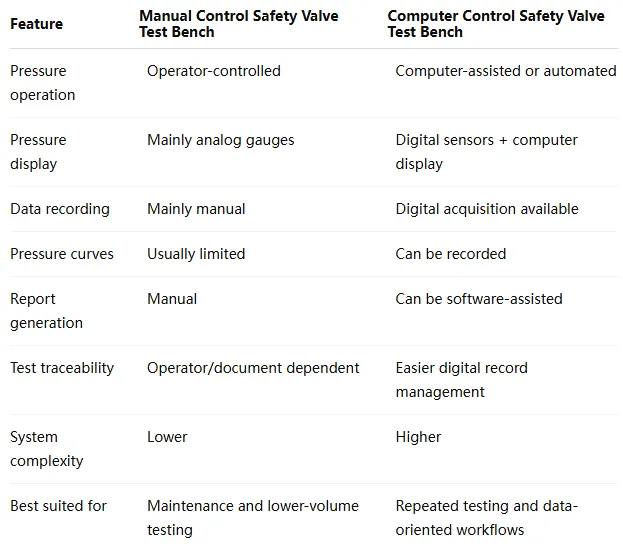
A manual control safety valve test bench is not obsolete simply because computer control is available.
The correct choice depends on how frequently valves are tested, what documentation is required, the skills of the operators, the applicable procedure, and how much automation provides meaningful value.
What Types of Valves Can a Safety Valve Test Bench Handle?
A safety valve test bench, also commonly searched as a PSV test bench or safety relief valve test bench, is primarily intended for pressure safety and relief valve applications.
However, valve dimensions and pressure requirements vary significantly between industries.
The machine therefore needs to be selected according to parameters such as:
- valve type;
- nominal diameter;
- inlet connection;
- flange standard;
- pressure class;
- required set pressure;
- test medium;
- maximum test pressure;
- test frequency;
- required measurement accuracy;
- required data output.
A buyer should not assume that every safety valve testing machine can test every PSV simply because the equipment has a sufficiently high maximum pressure.
Fixture compatibility, pressure control, connection arrangement, measurement range, and test medium are equally important.
Why Does Accurate Pressure Measurement Matter in PSV Testing?
A pressure safety valve operates in response to pressure.
That makes pressure measurement fundamental to the test.
If the pressure measurement chain is unsuitable for the required range, the operator may have difficulty evaluating the valve consistently.
Computer-controlled systems can integrate pressure transmitters or sensors with the software platform, allowing the test pressure to be displayed and recorded throughout the test sequence.
This can provide a more complete record than manually reading a single analog gauge.
However, digital acquisition does not eliminate the need for appropriate sensor selection and calibration.
Pressure range, accuracy, calibration traceability, environmental conditions, and the test procedure must still be considered during equipment configuration.
Why Is Data Acquisition Valuable for Valve Testing Equipment?
For buyers comparing valve testing equipment, data acquisition is often one of the main reasons to move from manual to computer control.
A recorded pressure curve provides information about how pressure changed during the test rather than preserving only one handwritten result.
Depending on the software configuration, operators may be able to record:
- test identification;
- valve information;
- pressure values;
- test duration;
- pressure curve;
- test date;
- operator information;
- test results.
This can be especially useful where customers need repeatable documentation across many valve tests.
The value of automation is therefore not simply that the machine “uses a computer.” Its value comes from how effectively the computer improves control, measurement, documentation, and workflow.
Is a Safety Valve Test Bench the Same as a Valve Test Bench?
Not exactly.
Valve test bench is a broad equipment category.
A general valve test bench or valve testing machine may be configured for gate valves, globe valves, ball valves, check valves, butterfly valves, control valves, or other industrial valves.
A safety valve test bench is a more specialized configuration focused on pressure safety valves and relief valves.
Buyers may encounter several related search terms:
- safety valve test bench;
- PSV test bench;
- safety relief valve test bench;
- pressure relief valve test bench;
- valve test bench;
- valve testing equipment;
- valve testing machine;
- valve pressure test bench;
- valve pressure testing equipment.
These terms can describe overlapping equipment categories, but they should not automatically be treated as identical machines.
When requesting a quotation, always specify the actual valve type and required test functions.
How Is a Safety Valve Test Bench Different From Hydrostatic Test Equipment?
Both belong to the broader category of pressure testing equipment, but their purposes differ.
A safety valve bench focuses on the behavior and verification of a valve under controlled pressure.
A hydrostatic test machine, hydrostatic pressure tester, or other hydrostatic testing equipment typically uses liquid pressure to verify pressure-containing components for strength, leakage, or pressure-holding performance.
Other pressure testing applications may require a leak test machine, burst test system, or fatigue test bench.
For buyers evaluating liquid versus gas testing methods, our Piping Pressure Test: Hydrostatic vs Pneumatic Methods Explained provides a practical comparison of the two pressure-test approaches.
What Was Checked During Installation and Commissioning in Jianyang?
For a customized test system, commissioning connects factory manufacturing with actual site operation.
The equipment needs to work with the utilities, environment, valve samples, and operating procedures available at the customer’s facility.
The commissioning process therefore focuses on the complete system rather than an isolated component.
Typical checks can include:
- Equipment positioning and installation.
- Utility and pressure-source connections.
- Pipeline and fitting inspection.
- Pressure sensor and gauge verification.
- Control-system communication.
- Valve fixture operation.
- Pressure-generation testing.
- Pressure regulation.
- Safety protection checks.
- Data acquisition verification.
- Software operation.
- Trial testing under the agreed operating conditions.
The Jianyang installation and commissioning work helped bring the customized منضدة اختبار صمام أمان التحكم بالكمبيوتر from manufactured equipment to an operational testing system ready for the customer’s intended workflow.
What Should Buyers Specify Before Ordering a Computer Control Valve Test Bench?
The more accurate the initial information, the more accurately a valve test bench manufacturer can configure the system.
Before requesting a quotation, prepare at least:
- Valve type — safety valve, relief valve, gate valve, globe valve, ball valve, etc.
- Valve size range — minimum and maximum nominal diameter.
- Pressure range — minimum working range and maximum required test pressure.
- Connection type — flange, thread, or other connection.
- Test medium — air, nitrogen, water, oil, or another compatible medium.
- Required tests — pressure verification, leakage, pressure holding, etc.
- Control method — manual, semi-automatic, PLC, or computer control.
- Data requirements — pressure curves, storage, reports, or export.
- Test frequency — occasional maintenance or continuous testing.
- Applicable standard or customer specification.
Providing these parameters is far more useful than simply asking for a generic safety valve test bench price.
What Determines the Price of a Computer Control Safety Valve Test Bench?
There is no meaningful universal price for this equipment because configuration can vary substantially.
Important cost drivers include:
- maximum test pressure;
- valve size range;
- test medium;
- pressure source;
- number of pressure ranges;
- fixture design;
- clamping method;
- pressure sensor configuration;
- automation level;
- computer and software requirements;
- data acquisition;
- report-generation requirements;
- safety enclosure and protection;
- applicable project specifications.
For example, two PSV test benches may both be described as computer-controlled systems but require very different pressure ranges, valve sizes, fixtures, sensors, and software functions.
A technically accurate quotation therefore begins with the application.
Why Choose Highlight / ODMT as Your Valve Test Bench Manufacturer?
Industrial buyers are rarely purchasing only a cabinet, fixture, or booster pump.
They are purchasing a complete testing capability.
Highlight develops customized high-pressure test systems by integrating pressure generation, pressure control, fixtures, instrumentation, electrical control, data acquisition, and application-specific engineering.
Our equipment capabilities include:
- Computer Control Safety Valve Test Bench;
- Manual Control Safety Valve Test Bench;
- automatic safety valve test bench;
- PSV test bench;
- safety relief valve test bench;
- valve test bench;
- valve testing equipment;
- hydrostatic testing equipment;
- hydrostatic pressure tester;
- pressure testing equipment;
- leak test machine;
- burst pressure test systems;
- pressure fatigue test systems;
- gas booster pump systems;
- أنظمة تعزيز السوائل.
ما سبقنا Czech customer valve test bench factory visit also shows how overseas customers evaluate customized valve testing solutions before equipment selection.
For buyers, the important advantage of this engineering approach is configuration flexibility. Instead of choosing equipment solely from a fixed catalog model, the test system can be developed around the component and procedure that actually need to be tested.
How Can You Get the Right Safety Valve Test Bench Configuration?
If you are sourcing a safety valve test bench, sending only the required maximum pressure is usually not enough.
To receive a useful technical proposal, send Highlight:
valve type + valve size range + pressure range + flange/connection information + test medium + required test functions + control method + applicable standard or customer specification.
If you already operate an older valve testing system, photographs and specifications of the existing equipment are also valuable.
Our engineers can then evaluate whether your project is better suited to a new Computer Control Safety Valve Test Bench, a manual configuration, or an upgrade of existing equipment.
الأسئلة الشائعة
What is a Computer Control Safety Valve Test Bench?
A Computer Control Safety Valve Test Bench integrates valve pressure testing equipment with digital sensors, computer-based monitoring, data acquisition, and configurable control functions. Depending on the project, it can support pressure monitoring, curve recording, test data storage, and report management.
What is the difference between a PSV test bench and a safety valve test bench?
The terms are frequently used for closely related equipment. PSV test bench generally refers to equipment for pressure safety valves, while safety valve test bench and safety relief valve test bench are broader industry descriptions. The actual machine configuration should always be matched to the valve and test procedure.
Can a computer-controlled valve test bench automatically generate test reports?
It can when report-generation functionality is included in the control and software configuration. Report fields, data format, storage requirements, and customer-specific templates should be confirmed during project engineering.
Can safety valve testing equipment use air or nitrogen?
Depending on the valve, test procedure, pressure range, and equipment configuration, gas media such as compressed air or nitrogen may be used. The pressure source, seals, piping, instrumentation, and safety measures must be designed for the selected medium.
Can Highlight customize a valve test bench?
Yes. Highlight can configure valve test bench systems according to valve type, size, pressure, test medium, fixture requirements, control method, data acquisition, and the customer’s applicable test specification.
How much does a Computer Control Safety Valve Test Bench cost?
Price depends on pressure range, valve dimensions, test medium, pressure source, clamping system, instrumentation, automation, software, and required test functions. Providing actual valve and test parameters is the best way to obtain an accurate technical proposal and quotation.
 English
 Français
 Русский
 Español
 Português
 العربية
 Tiếng Việt
 한국어
한국어 Bahasa Indonesia
 Deutsch
 Türkçe
 Italiano