



When petroleum storage tank accessories testing equipment is installed, the work does not stop at placing the main machine in the workshop. Test pipelines, flange connections, support frames, and related components must be prepared and assembled correctly. In this project, Highlight carried out installation work for a Mobile Petroleum Storage Tank Accessories Comprehensive Test Bench, including test pipeline fabrication and flange welding.
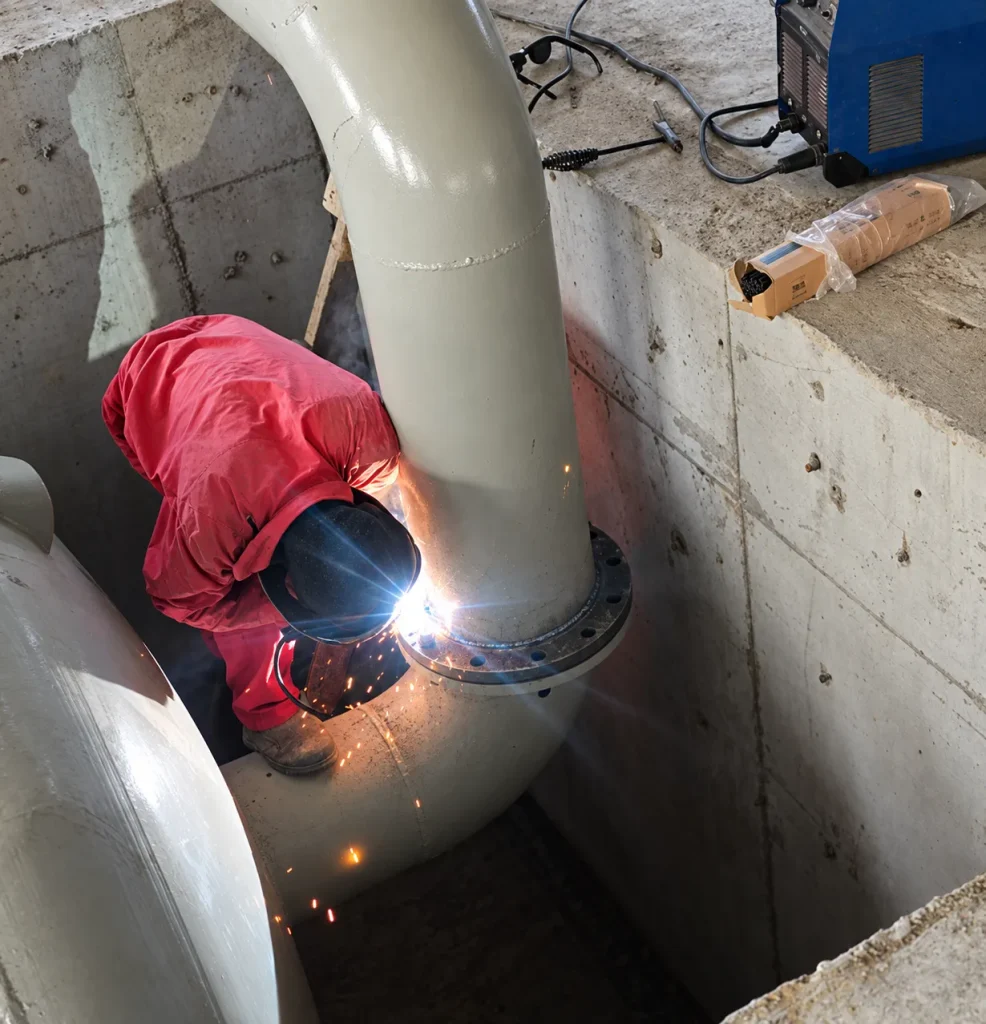
The project involved the installation and assembly of a Mobile Petroleum Storage Tank Accessories Comprehensive Test Bench. The available site information confirms that flange welding and pipeline-related fabrication were part of the work. The project photos show multiple fabricated pipe sections with flanged ends mounted on support frames, prepared as part of the testing equipment installation.
What Is a Mobile Petroleum Storage Tank Accessories Comprehensive Test Bench?
A Banc d'essai complet d'accessoires pour réservoirs mobiles de stockage de produits pétroliers is a specialized testing system designed for petroleum storage tank accessory testing. Unlike a simple standalone test instrument, a comprehensive test bench can incorporate different equipment sections, pipelines, connection components, measurement devices, and supporting structures into one testing setup.
For industrial users, the value of this type of equipment is closely related to how well the complete system matches the actual testing environment. The pipeline arrangement, connection interfaces, equipment layout, and operating requirements all need to be considered during installation.
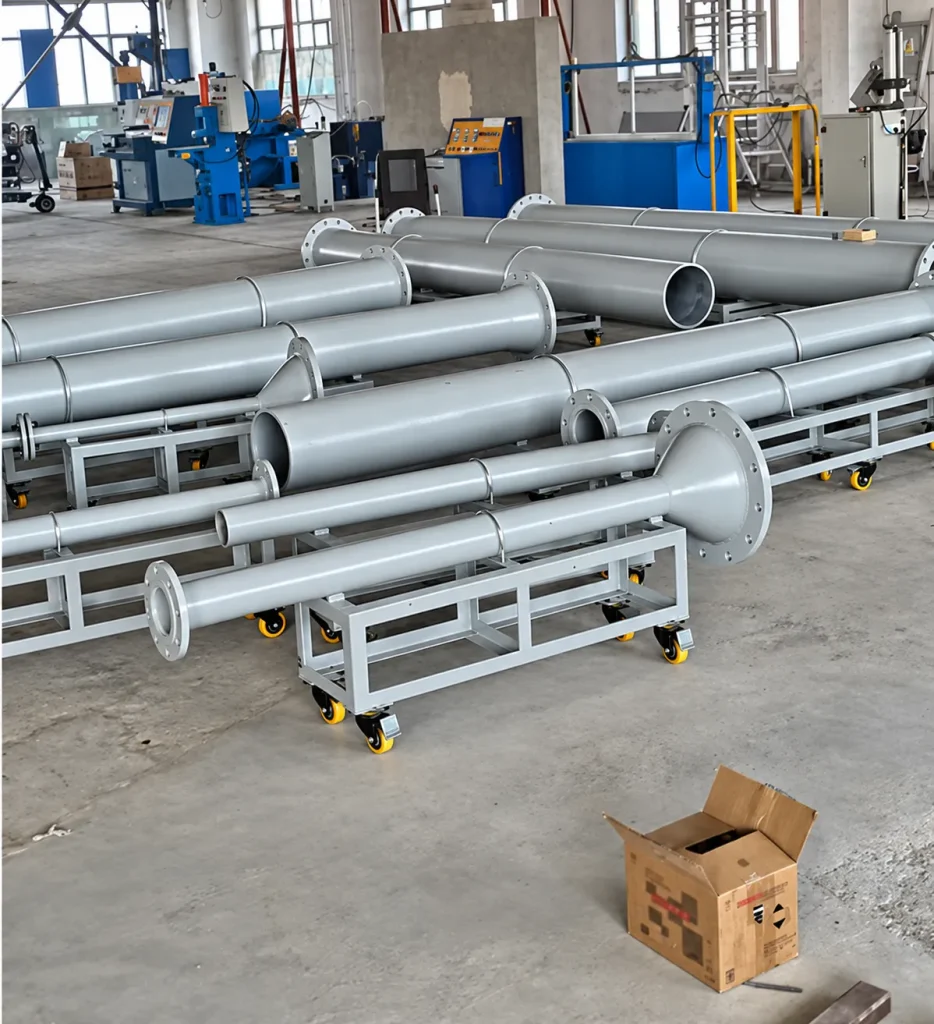
In the project shown in the photographs, Highlight worked on the installation of a Mobile Petroleum Storage Tank Accessories Comprehensive Test Bench. The images clearly show multiple large pipe assemblies, flanged ends, and metal support structures inside a workshop.
Why Is Pipeline Fabrication Important for Petroleum Storage Tank Testing Equipment?
A testing system needs an appropriate connection path between its testing components. This is where the test pipeline becomes important.
The photographs from this installation show several long pipe sections with circular flanges at their ends. These assemblies form part of the pipeline structure associated with the petroleum storage tank accessories testing system.
Pipeline fabrication needs to take account of the equipment layout and connection requirements. A well-arranged pipeline can make the testing system easier to install, operate, inspect, and maintain.
For a comprehensive testing system, the pipeline is therefore not simply an additional component. It is part of the overall system integration.
For customers sourcing petroleum storage tank accessories testing equipment, this is an important point to consider. The main testing machine and the associated pipeline should be evaluated as a complete system.
Flange Welding for the Mobile Petroleum Storage Tank Accessories Comprehensive Test Bench
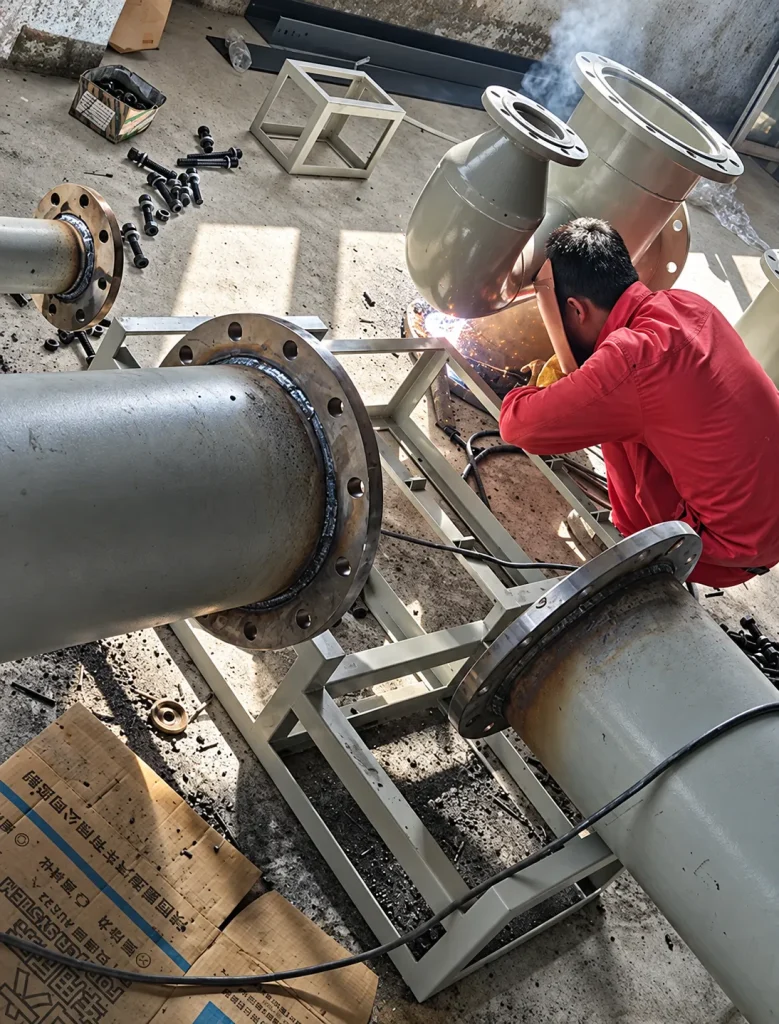
One of the documented activities in this project was flange welding.
A flange provides a mechanical connection interface between pipe sections and other equipment components. In industrial testing equipment, flanged connections can make it possible to assemble different sections of a pipeline and connect the pipeline with related equipment.
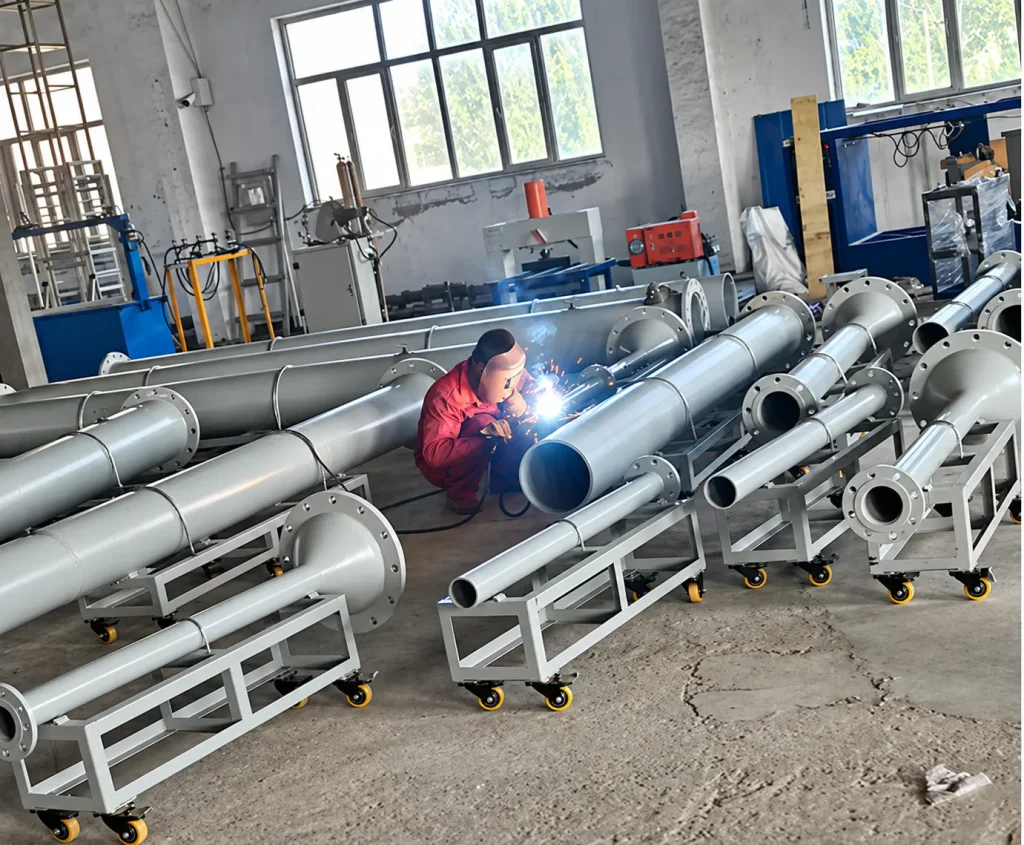
The project photographs show multiple pipe sections with welded flange ends. These components were being prepared as part of the equipment installation process.
The general fabrication process may include:
- Preparing pipe sections and flange components
- Positioning the flange according to the equipment design
- Performing the required welding work
- Inspecting the completed welded connection
- Positioning the pipe on its support frame
- Preparing the pipeline for connection with the testing equipment
The exact welding procedure, welding material, dimensions, and inspection requirements depend on the engineering documentation for the individual project.
For this reason, Highlight does not treat flange welding as an isolated workshop task. It is considered part of the broader testing equipment fabrication and system integration process.
How Are Petroleum Storage Tank Accessories Testing Equipment and Pipelines Integrated?
A petroleum storage tank accessories testing system can contain several interconnected sections. The test bench, pipeline, connection components, instruments, and support structures need to form a coordinated system.
The photographs provide a clear example of this physical integration process. Several pipe assemblies have already been fabricated, with flanges positioned at their connection ends. The pipes are mounted on steel support frames with casters.
This arrangement shows the relationship between:
Testing equipment → Pipeline → Flange connection → Support structure
Each section has a practical role in the overall installation.
For a testing equipment manufacturer, this type of integration requires attention to the relationship between the equipment and the workshop environment. Pipeline routing, access, connection points, and equipment positioning all influence the final arrangement.
What Does the Installation of a Mobile Test Bench Involve?
The installation of a Banc d'essai complet d'accessoires pour réservoirs mobiles de stockage de produits pétroliers can involve several stages, depending on the project design.
1. Component Preparation
The required pipe sections, flanges, support frames, and related equipment components are prepared.
2. Pipeline Fabrication
Individual pipe sections are fabricated according to the required system arrangement.
3. Flange Welding
Flanges are positioned and welded to the relevant pipe sections to create the required connection interfaces.
4. Support Frame Assembly
The fabricated pipe sections are positioned on their support structures. The photographs show support frames equipped with casters.
5. System Integration
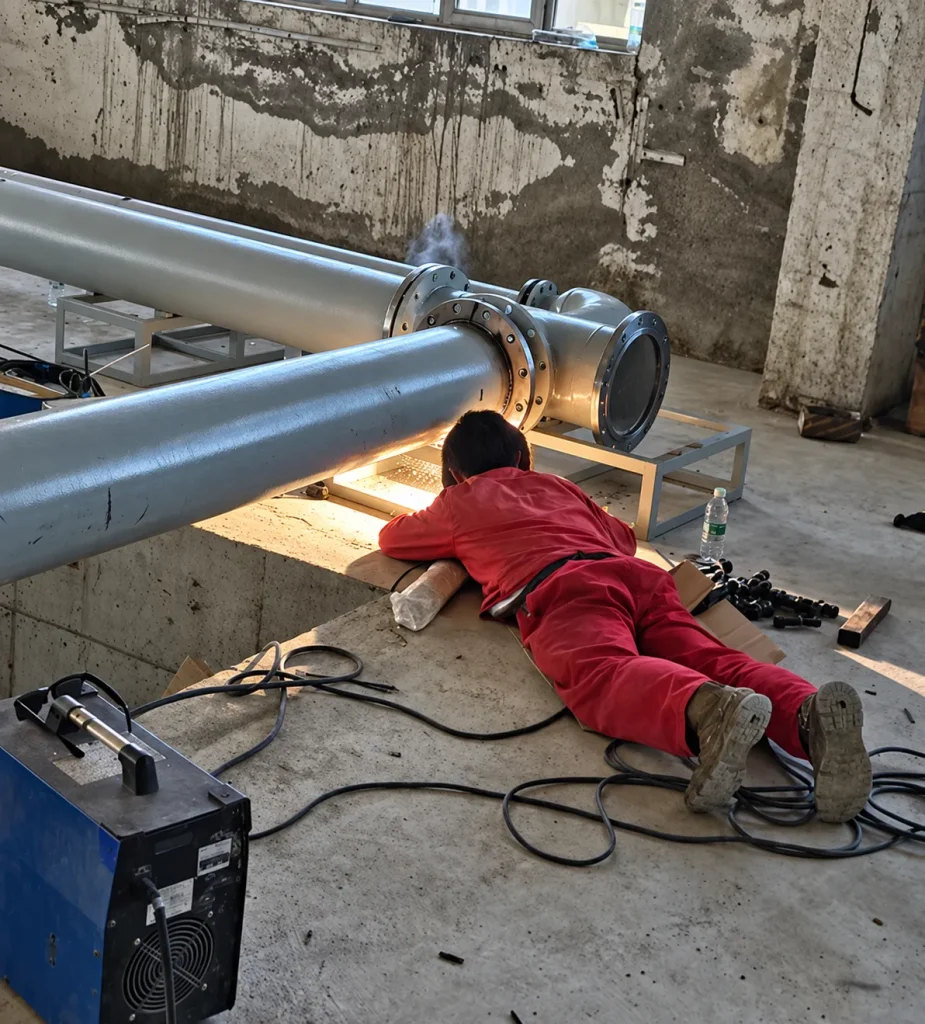
The prepared pipeline sections are integrated with the corresponding parts of the petroleum storage tank accessories comprehensive test bench.
6. Installation Inspection
The completed installation should then be checked according to the relevant project documentation and operating requirements before testing begins.
The exact sequence can vary according to the equipment configuration and site conditions.
Why Do Flanged Connections Matter in Test Pipeline Design?
Flanged connections are widely used where equipment sections need a mechanical connection that can be assembled and disassembled.
For a test pipeline, the flange provides a defined interface between connected sections. This can be particularly useful in equipment that requires maintenance, modification, or replacement of individual pipeline components.
The photographs in this project show large circular flange plates at the ends of several pipe assemblies. The flange arrangement is visibly integrated into the overall pipe structure.
However, the presence of a flange alone does not define the complete performance of a testing system. The final system depends on the relationship between the pipe, flange, sealing arrangement, support structure, valves, instruments, and other equipment components.
This is why choosing the right testing equipment configuration should begin with the customer’s actual testing requirements.
Petroleum Storage Tank Accessories Testing Equipment for Industrial Buyers
When purchasing petroleum storage tank accessories testing equipment, industrial buyers often need more than a standard machine.
A project may require consideration of:
| Key Requirement | What to Consider |
| Test application | Which petroleum storage tank accessories need to be tested? |
| Test pipeline | What pipeline arrangement is required? |
| Flange connection | What connection interfaces are required? |
| Equipment layout | How will the system fit within the workshop? |
| Support structure | How will the pipeline and equipment sections be supported? |
| Control method | Is manual or computer control required? |
| Milieu d'essai | What medium will be used for the intended test? |
| Pressure requirement | What operating and test conditions apply? |
| Integration | Does the system need to connect with other equipment? |
| Technical support | What installation and commissioning assistance is required? |
These questions help define the actual project scope before manufacturing begins.
For B2B customers, this approach is particularly important because petroleum equipment testing requirements can vary from one testing workshop to another.
How Does Highlight Approach Customized High-Pressure Testing Equipment?
Highlight is positioned as a global manufacturer of high-pressure testing equipment and fluid control systems.
Its business covers:
- Gas boosting
- Liquid boosting
- Contrôle des vannes
- Leak detection
- Hydrostatic testing
- Pressure testing
- Fluid control systems
- Complete testing line integration
- Standalone testing equipment
- Customized testing equipment
This means a testing project can be considered from both the equipment and system-integration perspective.
For petroleum storage tank applications, the requirement may involve more than the main testing machine. Pipeline fabrication, connection arrangements, support structures, control requirements, and installation can all form part of the engineering discussion.
Highlight therefore works with industrial customers to understand the actual application before determining the appropriate testing equipment configuration.
Petroleum Tank Testing Equipment: What Should Customers Prepare Before Ordering?
Customers planning a petroleum tank testing equipment project can make the engineering process more efficient by preparing basic application information.
Useful information can include:
- The type of petroleum storage tank accessories
- The components that need to be tested
- Required test procedures
- Milieu d'essai
- Pressure requirements
- Connection requirements
- Pipeline arrangement
- Available workshop space
- Preferred control method
- Installation and commissioning requirements
Not every project needs the same configuration.
A third-party testing laboratory, for example, may have different requirements from a petroleum equipment manufacturer or maintenance center. The equipment should therefore be designed around the actual application rather than selected only by a generic product name.
What Are the Benefits of a Customized Petroleum Storage Tank Test Bench?
A customized testing system can be designed around the customer’s actual component types, workshop layout, and testing workflow.
Potential benefits include:
Application Matching
The equipment can be planned around the components and testing procedures specified by the customer.
Better Pipeline Integration
The pipeline can be considered together with the main testing equipment instead of being treated as an unrelated component.
Flexible Equipment Layout
The support structure and pipeline arrangement can be planned according to the available workshop space.
Easier Maintenance
Well-planned connection points can help technicians access relevant sections during maintenance.
Complete Project Support
A manufacturer with system integration capabilities can address equipment, pipeline, control, and technical support requirements as part of one project.
These benefits depend on the actual engineering design and should not be treated as guaranteed results for every installation.
Highlight Supports Industrial Testing Equipment Projects
For industrial customers, equipment quality is only one part of a successful project.
Customers also need confidence in:
- Engineering communication
- Equipment configuration
- Pipeline integration
- Installation support
- Testing preparation
- Documentation technique
- Service après-vente
Highlight’s business is focused on high-pressure testing equipment and fluid control systems, serving industrial applications where testing accuracy, equipment stability, safety, and engineering support are important considerations.
The petroleum storage tank accessories project demonstrates this practical side of equipment delivery. The work includes physical pipeline fabrication, flange welding, support structure preparation, and installation of the testing equipment.
For customers planning similar projects, this system-level approach can provide a clearer starting point for technical discussions.
FAQ
What is a Mobile Petroleum Storage Tank Accessories Comprehensive Test Bench?
It is a comprehensive testing system designed for petroleum storage tank accessories, incorporating testing equipment and associated pipeline and connection components into an integrated setup. The exact testing functions depend on the project configuration.
Why is flange welding required during installation?
Flange welding is used to create the required flanged connection interfaces on the test pipeline. In this project, flange welding was one of the documented installation and fabrication activities.
Are the pipe assemblies in the photos part of the test bench?
The photographs show multiple pipe assemblies with flanged ends and support frames as part of the equipment installation process. They form part of the pipeline-related structure of the testing system.
Is the Mobile Petroleum Storage Tank Accessories Comprehensive Test Bench customized?
The project information identifies the equipment as a Banc d'essai complet d'accessoires pour réservoirs mobiles de stockage de produits pétroliers. Specific customization details are not provided in the available project information, so individual design specifications should be confirmed from the project documentation.
Can Highlight provide complete testing line integration?
Yes. Highlight’s business includes complete testing line integration in addition to standalone high-pressure testing equipment and fluid control systems.
Does the project include confirmed pressure testing results?
The available information confirms equipment installation and flange welding, but it does not provide specific pressure test results or commissioning data. Therefore, no specific test result is claimed in this case study.
 English
 Français
 Русский
 Español
 Português
 العربية
 Tiếng Việt
 한국어
한국어 Bahasa Indonesia
 Deutsch
 Türkçe
 Italiano