



Industrial safety valves require reliable testing equipment to verify their operating performance. When an existing test bench no longer fully matches current testing requirements, replacing the entire system is not always necessary. A targeted safety valve test bench upgrade can improve pressure control, operation, and long-term usability while retaining suitable existing equipment.
Highlight / ODMT recently completed the upgrade of a Manual Control Safety Valve Test Bench in Suining, China. The project focused on improving the existing valve testing system according to the customer’s actual workshop conditions and safety valve inspection requirements.
The completed project provides another practical example of how an existing valve test bench can be rebuilt and optimized rather than simply replaced.
What Was the Manual Control Safety Valve Test Bench Upgrade Project in Suining?
The project involved upgrading an existing manual control safety valve test bench used for safety valve inspection and pressure testing.
Unlike supplying a completely new machine, a retrofit project begins with the customer’s existing equipment. Our engineers must first understand the original pressure circuit, gauges, control components, test clamping arrangement, available utilities, and the types of valves being tested.
Based on these conditions, Highlight developed an upgrade solution intended to make the existing safety valve testing equipment more suitable for the customer’s current testing workflow.
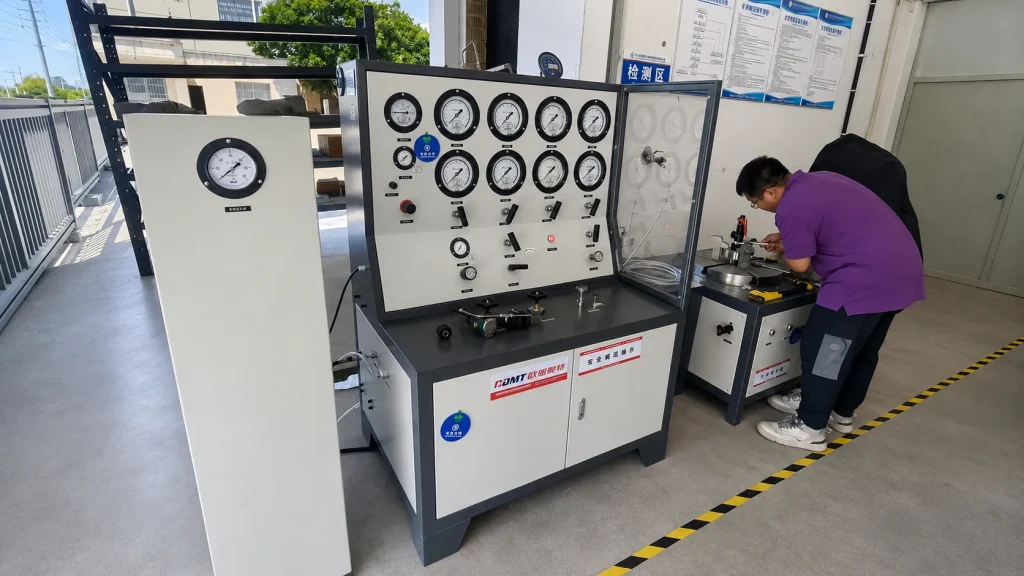
The completed system integrates the pressure-control section, multiple pressure gauges, manual operating valves, test connections, hydraulic components, and a dedicated valve test station.
This type of solution can be particularly useful for inspection departments, maintenance workshops, valve service companies, industrial plants, and organizations that already own a valve testing machine but need to improve its performance.
Why Upgrade an Existing Safety Valve Test Bench Instead of Replacing It?
A complete replacement is not automatically the best option.
Many older safety valve test benches still have usable mechanical structures, fixtures, cabinets, or other components. Their limitations may instead come from aging pressure-control components, an unsuitable pressure range, outdated piping, inconvenient manual controls, or changes in the valves the workshop now needs to test.
A retrofit allows engineers to evaluate these elements separately.
Depending on the existing machine and required testing scope, an upgrade may involve:
- pressure circuit modification;
- pressure gauge replacement or rearrangement;
- pneumatic or hydraulic circuit optimization;
- control valve replacement;
- pressure source modification;
- test connection changes;
- fixture or clamping-system adaptation;
- electrical component upgrades;
- safety protection improvements;
- maintenance-access improvements.
The objective is not simply to make an old valve test machine look newer. The upgraded system must match the customer’s actual valve sizes, pressure ranges, test procedures, media, and operating practices.
What Can a Manual Control Safety Valve Test Bench Be Used For?
A Manual Control Safety Valve Test Bench provides a controlled platform for inspecting safety valves and safety relief valves outside the process system.
Depending on its configuration, the equipment can support testing activities associated with safety valve opening behavior, pressure holding, leakage inspection, and other verification procedures required by the customer’s test specification.
This makes the equipment relevant to users searching for terms such as:
safety valve test bench, safety relief valve test bench, PSV test bench, valve test bench, valve testing equipment, valve testing machine, and pressure testing equipment.
However, these terms do not always describe identical machines. A valve test bench must be configured according to the actual valve type and testing requirement.
For example, a general-purpose valve test bench intended for gate valves or ball valves may have different clamping, sealing, pressure, and leakage-testing requirements from a dedicated safety valve test bench.
What Does Manual Control Mean on a Safety Valve Test Bench?
Manual control means the operator directly manages important test functions through mechanical or manually operated control components rather than relying on a fully automated PLC sequence.
As visible in the completed Suining system, the control panel provides multiple analog pressure gauges and manual operating controls. This gives trained operators direct visibility over different pressure circuits and allows them to adjust the test process according to the applicable procedure.
Manual systems remain useful in many maintenance and inspection environments because they can offer:
- straightforward operation;
- direct pressure adjustment;
- clear analog pressure indication;
- easier troubleshooting;
- flexible handling of different test conditions;
- lower automation complexity.
That does not mean a manual safety valve testing machine is inherently better than an automatic system.
For facilities performing large numbers of repetitive tests, an automatic or computer-controlled valve test bench with digital pressure acquisition, test-curve recording, and report generation may be more suitable.
The correct control architecture depends on test volume, documentation requirements, operator practices, and budget.
How Does Pressure Control Affect Safety Valve Testing?
Pressure control is one of the most important parts of a safety valve test bench.
The test pressure must be raised in a controlled manner so the operator can observe valve behavior around the required pressure point. An unstable or poorly controlled pressure source can make testing less repeatable and complicate interpretation.
This is why the pressure-generation and regulation system is a central part of both new pressure test equipment and retrofit projects.
Depending on the required pressure, medium, and application, a test system may incorporate hydraulic pumps, pneumatic pressure intensifiers, gas booster systems, regulators, valves, gauges, and pressure-relief components.
Highlight also manufactures dedicated gas booster pump and liquid pressure-boosting solutions for applications requiring higher gas or liquid pressures.
For buyers evaluating the complete pressure-generation side of a test system, see our Gas Booster Pump solutions.
Safety Valve Test Bench vs General Valve Test Bench: What Is the Difference?
The two terms overlap, but the application determines the configuration.
A valve test bench is a broad category of equipment used to test industrial valves. Depending on the machine, it may be designed for gate valves, globe valves, ball valves, butterfly valves, check valves, safety valves, or several valve families.
A safety valve test bench or PSV test bench is more specifically configured around safety and pressure-relief valve inspection.
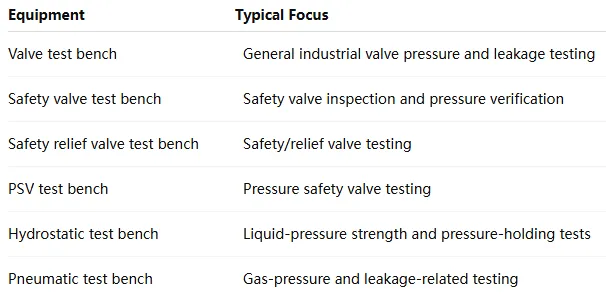
The terminology therefore matters when requesting quotations.
Simply asking for a “valve testing machine” gives a manufacturer too little information to configure the equipment accurately.
What Information Is Needed to Upgrade a Valve Test Bench?
A successful retrofit starts with understanding the existing equipment and the required end result.
For a valve test bench manufacturer, useful project information normally includes:
- Existing test bench photos and nameplate information.
- Valve types being tested.
- Minimum and maximum valve sizes.
- Required test-pressure range.
- Available compressed-air, hydraulic, and electrical supply.
- Required test medium.
- Existing fixture and clamping arrangement.
- Manual, semi-automatic, or automatic control preference.
- Required pressure measurement and recording method.
- Applicable customer specifications or test standards.
This information allows the engineering team to determine whether the existing valve testing equipment can be upgraded effectively and which components should be retained, modified, or replaced.
What Did the Suining Test Bench Upgrade Focus On?
For the Suining project, the work centered on adapting the existing manual safety valve testing system to the customer’s current operating requirements.
The finished installation shows a centralized manual control console equipped with multiple pressure gauges and operating valves, together with the associated pressure-generation and control components housed within the equipment.
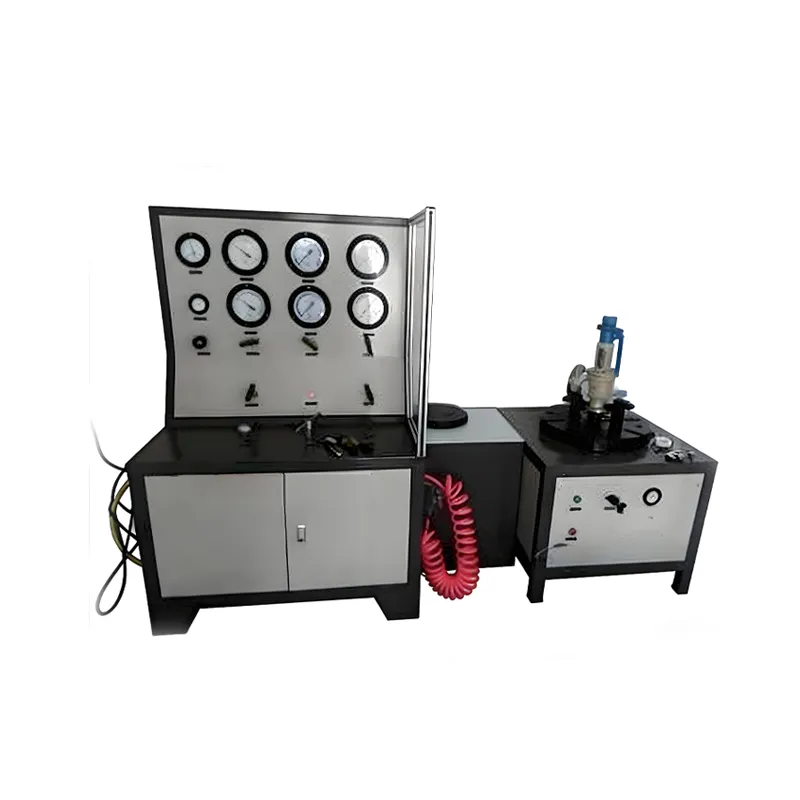
The separate valve testing station provides the working area for mounting and testing the valve.
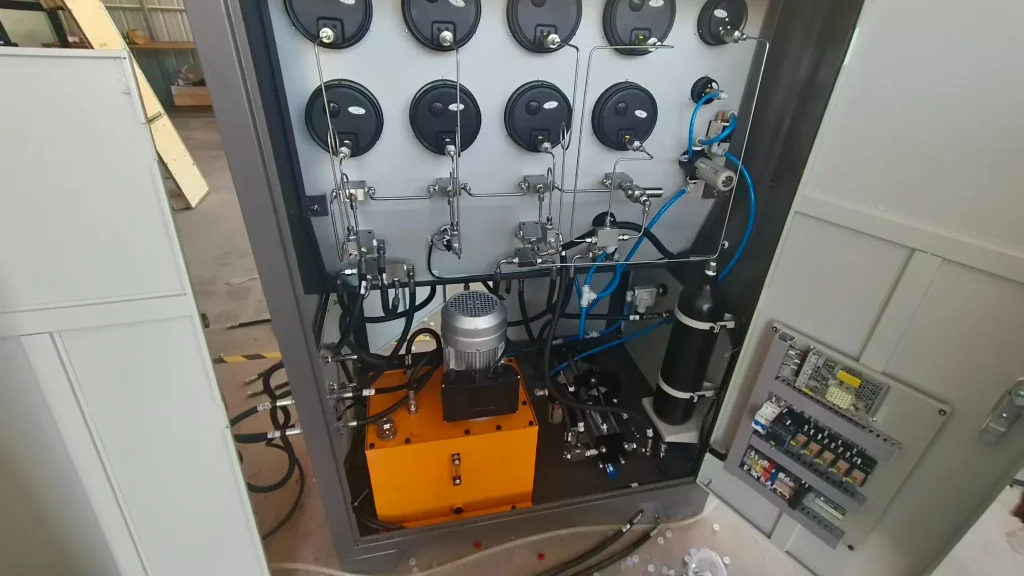
The internal equipment arrangement also demonstrates an important part of test-bench engineering that is often invisible in catalog photographs: the network of tubing, valves, pressure-control components, hydraulic equipment, electrical hardware, and connections behind the operator panel.
For a custom pressure test system, these internal components matter as much as the external enclosure because they determine how pressure is generated, controlled, isolated, measured, and released.
Why Is Customization Important for Valve Testing Equipment?
Industrial valves vary considerably.
Nominal diameter, flange standard, pressure class, valve geometry, required test medium, opening pressure, and inspection procedure can all affect the design of the test bench.
For that reason, professional valve test bench manufacturers normally need application data before confirming a configuration.
Highlight / ODMT develops customized test systems based on actual project requirements rather than forcing every customer into one fixed machine configuration.
Our broader capabilities include:
- valve test bench systems;
- safety valve test bench systems;
- safety relief valve test bench solutions;
- PSV test bench configurations;
- hydrostatic test equipment;
- hydrostatic pressure test equipment;
- pneumatic pressure testing equipment;
- leak test machine systems;
- burst test bench systems;
- pressure-holding systems;
- fatigue and cyclic pressure test equipment;
- gas and liquid booster systems.
For piping and component applications where the choice of liquid or gas test medium is important, our guide Piping Pressure Test: Hydrostatic vs Pneumatic Methods Explained explains the differences from an equipment and operating perspective.
What Can Buyers Learn From a Real Valve Test Bench Retrofit?
A retrofit project demonstrates something that a standard product specification cannot: whether the supplier can work around existing equipment.
New-machine manufacturing starts from a controlled design. An upgrade starts with someone else’s installed system, available workshop space, existing utilities, old components, and established operating habits.
That requires the manufacturer to understand not only individual components but the entire pressure test system.
Our previous Manual Control Safety Valve Test Bench upgrade project in Zhanhua provides another example of this engineering approach.
Together, these projects show how Highlight supports both new valve test bench manufacturing and modernization of existing safety valve testing systems.
When Should You Consider Retrofitting Your Existing Valve Test Bench?
An upgrade may be worth evaluating when the basic machine remains serviceable but the existing system no longer meets operational requirements.
Common situations include:
- the required valve range has changed;
- test pressure requirements have increased;
- gauges or control components are aging;
- pressure regulation has become difficult;
- the pressure circuit needs modification;
- the original test medium has changed;
- existing fixtures no longer suit current valves;
- operators need a more convenient control arrangement;
- maintenance is becoming increasingly difficult;
- the facility wants to improve safety protection;
- the workshop needs additional test functions.
A technical assessment should come before deciding between retrofit and replacement.
In some cases, upgrading the existing safety valve testing equipment makes sense. In others, building a new test bench provides a better long-term solution.
Why Work With Highlight / ODMT for Safety Valve Test Equipment?
Highlight specializes in high-pressure testing and pressure-boosting equipment for industrial applications.
Instead of treating a safety valve test bench as a generic machine, we evaluate the complete testing requirement: pressure, medium, valve geometry, clamping, control, measurement, safety, and operating workflow.
Our engineering capabilities cover both standalone pressure equipment and integrated test systems, allowing us to support new equipment, customized configurations, and existing-machine upgrade projects.
The completed Suining Manual Control Safety Valve Test Bench upgrade adds another practical project to that experience.
For users planning a similar project, the most useful starting point is not simply asking, “How much does a valve test bench cost?”
Send us the valve type, size range, pressure range, test medium, current equipment photos, and required test functions. That information gives our engineers a much better basis for evaluating whether your existing system should be upgraded or replaced.
FAQ
What is a safety valve test bench?
A safety valve test bench is specialized testing equipment used to inspect safety valves or pressure relief valves under controlled pressure conditions. The exact test functions depend on the valve type, test medium, pressure range, and applicable test procedure.
What is a PSV test bench?
A PSV test bench is a test system designed for pressure safety valves. Depending on its configuration, it may be used for pressure verification, leakage-related testing, and other safety valve inspection procedures.
Can an old valve test bench be upgraded?
Yes, many existing valve test benches can be upgraded if their main mechanical structure and suitable components remain usable. The manufacturer should inspect the existing pressure system, fixtures, controls, gauges, and required new functions before recommending a retrofit.
Can Highlight customize a manual control safety valve test bench?
Yes. Highlight develops customized manual control safety valve test bench configurations according to valve type, valve size, pressure range, test medium, control requirements, and customer specifications.
Is manual or automatic valve testing equipment better?
Neither is universally better. Manual equipment provides straightforward direct control and can suit maintenance or inspection workshops. Automated valve testing equipment is often preferable where repetitive testing, digital data acquisition, traceability, or automatic reports are required.
What information should I provide when requesting a valve test bench quotation?
Provide the valve type, nominal size range, pressure class or required test pressure, test medium, flange or connection information, desired control method, applicable standard, and required test functions. For retrofit projects, also provide clear photographs and specifications of the existing equipment.
 English
 Français
 Русский
 Español
 Português
 العربية
 Tiếng Việt
 한국어
한국어 Bahasa Indonesia
 Deutsch
 Türkçe
 Italiano