



A gas pressure gauge test verifies a gauge’s accuracy using a gas medium — typically nitrogen, air, or another inert gas — rather than liquid. Because gas compresses and expands differently than liquid, the test procedure has to account for temperature effects and longer stabilization windows that liquid-media calibration doesn’t face.
Why Gas Behaves Differently Under Pressure
Liquid is nearly incompressible. When a calibration technician pressurizes a liquid-filled system, the volume change is small and the pressure reading stabilizes almost immediately. Gas is the opposite. Compressing a gas rapidly does mechanical work on the molecules, and that work shows up as a temporary temperature rise inside the test chamber — the adiabatic effect. A gauge reading taken during that heat spike will run high, then drift downward as the gas cools back to ambient temperature over the following seconds or minutes.
This isn’t a defect in the gauge or the test bench. It’s a property of gas compression itself, and it means gas-media calibration procedures need a built-in stabilization pause before any reading counts as valid. Skip that pause, and the “calibrated” gauge will actually be biased against its liquid-tested counterpart — a discrepancy that shows up later as an inexplicable field complaint rather than a calibration-bench problem.
A second difference: gas is compressible enough that small leaks matter more. A liquid system with a pinhole leak might hold pressure for a useful test window before the operator notices a drop. A gas system with the same size leak can lose test pressure fast enough to invalidate a reading before stabilization even completes. Gas-rated test benches need tighter seal tolerances than their liquid counterparts for this reason.
The Mistake Most Gauge Shops Make
The most common error in gas-media testing isn’t a calibration math mistake — it’s timing. Operators trained primarily on liquid systems carry that habit into gas testing and record the reading as soon as the target pressure is reached, without waiting for thermal equilibrium. On a low-pressure gauge this error may be small enough to stay within tolerance. On a gauge near the top of its rated range, or on a precision instrument gauge with a tight accuracy class, the same shortcut can push a passing gauge into a failing reading, or worse, let a genuinely out-of-tolerance gauge pass because the inflated reading happened to land inside the acceptance band.
How a Gas Pressure Gauge Test Is Performed
1.Mount the gauge on the test port using the correct thread and pressure-class fitting; check for damage or contamination before applying any pressure.
2.Purge the system with the test gas to remove residual air or moisture, particularly important for gauges that will see service on nitrogen or another dry-gas application.
3.Pressurize incrementally to each test point rather than jumping directly to full scale — this limits the size of the adiabatic temperature spike at any one step.
4.Pause for stabilization at each test point before recording a reading. The required wait time depends on chamber volume and pressure step size, so shops running frequent gas calibrations typically standardize a minimum pause per test point rather than judging it by eye.
5.Record the reading against the reference standard and calculate deviation.
6.Repeat across the full test range, both ascending and descending, to check for hysteresis.
7.Vent the system slowly rather than releasing pressure all at once, which avoids introducing a cooling shock that can affect the next gauge in a batch run.
Gas-Media vs. Liquid-Media Calibration
| Factor | Gas-Media Calibration | Liquid-Media Calibration |
| Compressibility | High — significant volume change under pressure | Low — near-incompressible |
| Temperature effect | Adiabatic heating on rapid pressurization | Minimal |
| Stabilization time | Required pause at each test point | Near-instant |
| Leak sensitivity | High — small leaks affect pressure quickly | Lower — pressure holds longer through minor leaks |
| Typical media | Nitrogen, air, inert gas | Water, calibration oil |
| Best suited for | Gauges in gas service (nitrogen systems, gas pipelines, pneumatic equipment) | Gauges in liquid service (hydraulic, hydrostatic) |
The distinction matters for gauge manufacturers specifically: a gauge stamped and sold for gas service should be calibrated in gas, not liquid, because the internal Bourdon tube or diaphragm can respond slightly differently to the two media at the margins of its accuracy class. Testing a gas-rated gauge exclusively on a liquid bench doesn’t fully validate it for the environment it will actually operate in.
Compared with the calibration-service and field-calibrator content that currently dominates search results for gauge testing, most of that material treats gas and liquid calibration as interchangeable topics or focuses on portable field verification rather than the bench-side gas calibration workflow that gauge manufacturers run before a product ships.
Equipment Side: Gas Pressure Gauge Calibration Tables
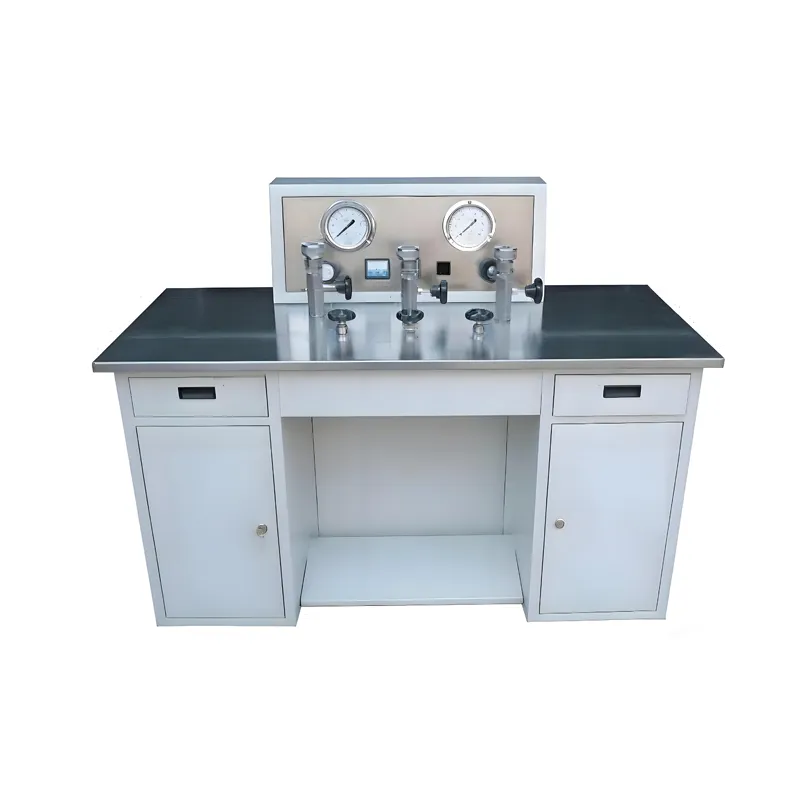
Production-line gauge testing for gas media uses a dedicated gas pressure gauge calibration table rather than a liquid calibration bench, since the fixture, seal materials, and pressure-generation method differ between the two. Highlight’s Product Line 8 includes the MFCG15 Gas Pressure Gauge Calibration Table alongside the MFCL liquid calibration table and continuous-test MFCV01-1 model, positioned for manufacturers running gas-gauge production or batch verification rather than single-unit field checks.
Specific pressure range, test-point capacity, and stabilization-cycle parameters for the MFCG15 should be confirmed against the current product datasheet before publishing exact figures — this article intentionally avoids stating numbers not yet verified against the internal specification sheet.
What This Doesn’t Cover
This is an explainer on gas-media calibration principles and procedure, not a full accuracy-class reference or a metrology certification guide. Shops needing traceability documentation, uncertainty budgets, or specific national metrology standards for their region should confirm those requirements separately, since certification requirements vary by destination market and gauge accuracy class.
SSS
Q: Can the same test bench calibrate both gas and liquid gauges?
A: Some benches are built with dual-media capability, but a bench optimized for gas testing (seal materials, leak tolerance, stabilization control) isn’t automatically optimal for liquid testing and vice versa. Confirm the intended media mix before selecting equipment.
Q: How long should a gas gauge sit at a test point before recording a reading?
A: It depends on chamber volume, pressure step size, and ambient conditions, so there’s no single universal number — shops running frequent gas calibrations typically establish a standardized minimum pause based on their own equipment and validate it periodically rather than estimating it per test.
Q: Does nitrogen calibration differ from air calibration?
A: The adiabatic behavior is similar across most inert and dry gases; the bigger practical difference is contamination control — nitrogen systems are more sensitive to moisture and oil carryover than general compressed air.
Q: Why would a gauge pass a liquid test but fail a gas test?
A: If the gauge’s internal mechanism responds slightly differently to gas versus liquid pressure at the margins of its accuracy class, a liquid-only test can miss a deviation that only appears under gas conditions — which is why gas-service gauges should be tested in gas.
Q: Is gas-media calibration more expensive than liquid calibration?
A: Equipment and consumable costs vary by model, test volume, and automation level; contact the manufacturer for a quote based on your specific test-point range and throughput requirements.
 English
 Français
 Русский
 Español
 Português
 العربية
 Tiếng Việt
 한국어
한국어 Bahasa Indonesia
 Deutsch
 Türkçe
 Italiano