



Petroleum storage tank safety accessories cannot be judged by appearance alone. If breathing valves, hydraulic safety valves, flame arresters, or related components are not tested correctly, inspection work becomes harder and less consistent. A properly configured test bench provides a controlled way to perform pressure, vacuum, flow, and related performance checks.
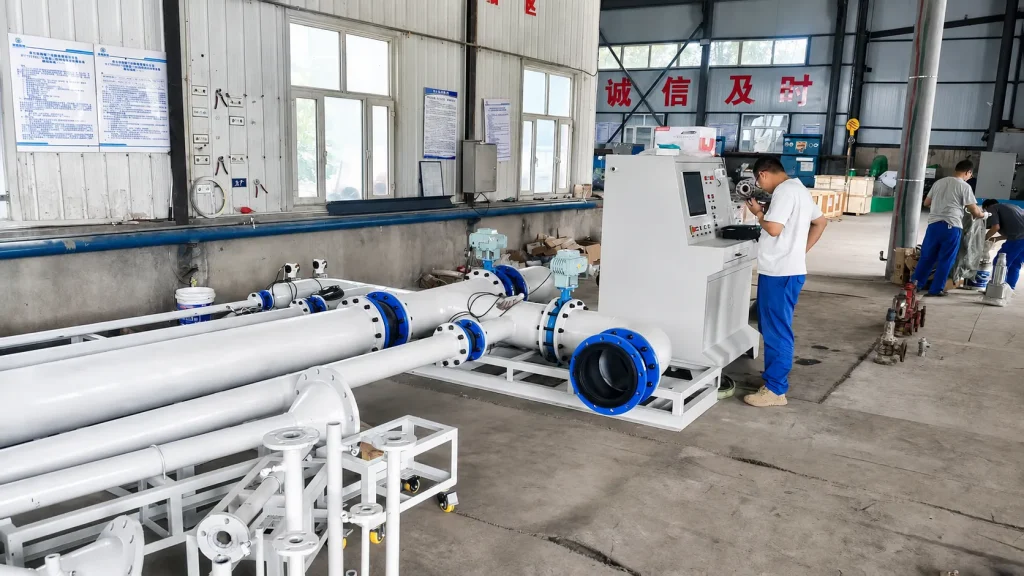
At the Kuqa, Xinjiang project site, Highlight is carrying out the wiring work for a Mobile Petroleum Storage Tank Accessories Comprehensive Test Bench. The equipment is designed for comprehensive inspection of petroleum storage tank accessories, including breather valves, hydraulic safety valves, and flame arresters, with testing functions configured according to the project requirements.
On-Site Wiring for a Petroleum Storage Tank Accessories Test Bench
The latest project update from Kuqa, Xinjiang, focuses on the on-site wiring stage of a Mobiles Erdöltankzubehör Umfassender Prüfstand. The equipment has arrived at the customer site, and technical personnel are working on the electrical and control connections required for subsequent operation.
For an industrial testing project, wiring is more than simply connecting cables. The electrical system needs to work together with pressure sources, vacuum circuits, flow measurement, valves, sensors, instruments, and the control system. Correct connection is therefore an important step before functional testing and commissioning.
Highlight develops pressure testing equipment and fluid control testing systems, including tank accessory test benches, safety valve test benches, valve test benches, pressure gauge testing equipment, gas boosting systems, and liquid pressure testing equipment. The company states that its engineering team supports test bench configuration, fixture matching, and technical support.
What Is a Mobile Petroleum Storage Tank Accessories Comprehensive Test Bench?
A Mobiles Erdöltankzubehör Umfassender Prüfstand is an integrated testing system designed for inspection of safety accessories used on petroleum storage tanks and related tank systems.
Unlike a single-purpose test fixture, a comprehensive tank accessory test bench can combine different test circuits, instruments, fixtures, valves, and control components within one system. The exact configuration depends on the customer’s testing objects and confirmed technical requirements.
The product information published by Highlight describes the system as suitable for comprehensive testing of breather valves, hydraulic safety valves, and tank flame arresters used on petroleum storage tanks.
A system of this type can be designed around several testing requirements, including:
- Positive-pressure testing
- Vacuum testing
- Opening-performance inspection
- Sealing inspection
- Airflow measurement
- Pressure-difference measurement
- Pressure-loss evaluation
- Component-specific performance verification
The purpose is not simply to generate pressure. The complete testing system must provide the appropriate test condition, connect the test object correctly, measure the response, and allow technicians to evaluate the result.
Why Is Correct Wiring Important for Tank Testing Equipment?
A modern tank testing system may contain several electrical and measurement components. The control cabinet needs to communicate correctly with sensors, instruments, valves, pumps, pressure sources, and other system components.
Incorrect wiring can affect signal transmission, control logic, instrument display, or equipment operation. In a pressure testing environment, this can also make troubleshooting more difficult.
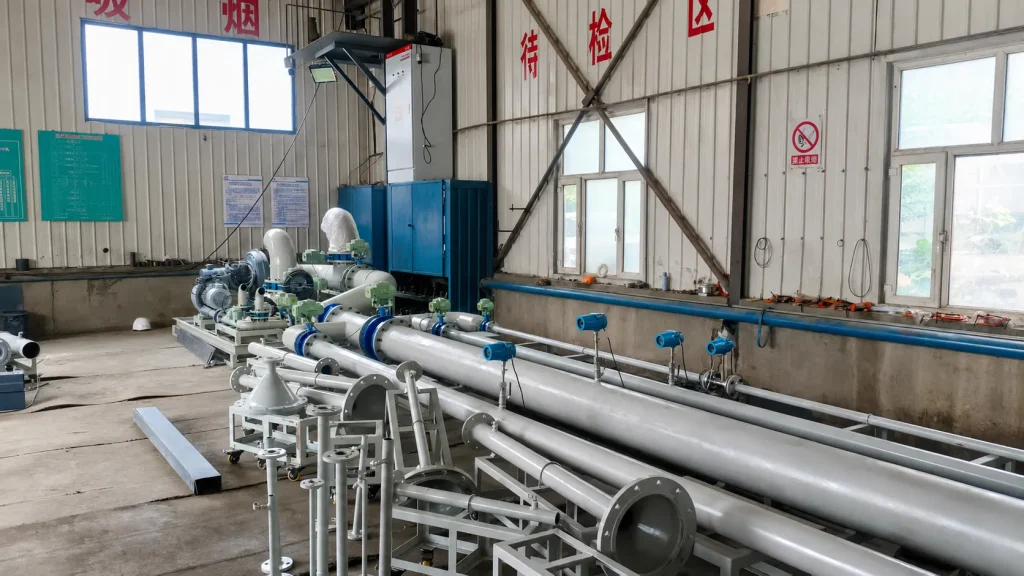
At the Kuqa site, the visible control cabinet and interconnected test modules show that the project involves more than one independent machine. The equipment has been arranged as a coordinated testing system, so the wiring stage forms an important connection between the mechanical equipment and the control system.
For buyers, this is one reason to evaluate a tank testing equipment manufacturer not only by the machine itself but also by its engineering and commissioning capability.
A complete project may involve:
- Technical requirement confirmation
- Equipment manufacturing
- Factory inspection
- Transportation
- Equipment positioning
- Electrical wiring
- Pipeline and instrument connection
- Functional checking
- Commissioning
- Bedienerschulung
The exact sequence can vary according to the project.
What Tank Accessories Can Be Tested?
Petroleum storage tanks use different safety accessories to manage pressure, vacuum, venting, and flame-related risks. The required testing method depends on the design and function of each component.
Breather Valves
Breather valves, also called breathing valves in many industrial applications, help manage pressure and vacuum conditions in storage tanks.
A breather valve test bench can be configured to evaluate parameters such as:
- Positive opening pressure
- Vacuum opening pressure
- Sealing performance
- Reseating behavior
- Airflow performance
- Pressure difference
The appropriate test procedure and measuring range should be selected according to the actual valve and applicable inspection requirements.
Hydraulic Safety Valves
Hydraulic safety valves are another type of tank protection component that may require controlled inspection.
A hydraulic safety valve test bench can provide the pressure conditions required to evaluate the response of the component. Fixture design, connection method, test range, and measurement equipment should match the specific valve.
Flame Arresters
Flame arresters are also important tank accessories. Their testing requirements are different from those of a pressure vacuum valve.
Depending on the configured system and test procedure, flame arrester inspection can involve airflow and pressure-loss measurement. The test arrangement may require suitable fixtures, stable airflow, pressure measurement, and flow measurement.
This is why a comprehensive petroleum storage tank accessories testing equipment solution needs to be designed around actual test objects rather than using one generic fixture for everything.
How Does the Test Bench Combine Pressure, Vacuum and Flow Testing?
Tank accessories can operate under different pressure and airflow conditions. A testing system therefore may require more than a conventional pressure source.
For example, a pressure-vacuum valve may need both positive-pressure and negative-pressure conditions. A breather valve may require airflow testing in addition to opening-pressure verification. A flame arrester may require airflow and pressure-loss evaluation.
The product information for Highlight’s related tank accessory equipment describes systems that can integrate positive-pressure generation and control, negative-pressure or vacuum test circuits, airflow-generation equipment, pressure and vacuum instruments, flow measurement devices, electrical control cabinets, interchangeable fixtures, test pipelines, and valves, depending on the confirmed project configuration.
This integrated approach helps technicians perform different inspection tasks through a coordinated platform.
For industrial buyers, the key question should therefore be:
What exactly needs to be tested, and what test conditions must be reproduced?
The answer determines the pressure source, vacuum source, measurement range, fixtures, valves, sensors, pipelines, and control configuration.
What Can Buyers Learn from the Kuqa Installation?
The Kuqa project highlights an important point about purchasing industrial testing equipment: equipment delivery is only one part of a complete project.
For a customer purchasing a customized tank accessory test bench, several practical questions should be discussed before production:
| Project Item | Information to Confirm |
|---|---|
| Test objects | Breather valves, hydraulic safety valves, flame arresters, etc. |
| Test functions | Pressure, vacuum, flow, sealing and other required tests |
| Druckbereich | Required positive-pressure range |
| Vakuumbereich | Required negative-pressure range |
| Flow requirements | Required airflow measurement range |
| Connections | Flanges, threads and other interfaces |
| Fixtures | Sizes and types of components to be tested |
| Kontrolle | Manual, PLC/HMI or other confirmed configuration |
| Installation | Workshop layout and available utilities |
| Service | Installation, commissioning and technical support |
This information allows the manufacturer to develop a more appropriate testing solution.
Why Is a Customized Tank Accessory Test Bench Often Necessary?
Not every petroleum storage facility uses exactly the same accessories. Components can differ in size, connection type, structure, operating range, and testing requirements.
A standard machine may be suitable for a specific range of components, but a comprehensive testing project may require multiple fixtures and test circuits.
Customization can focus on practical requirements such as:
- Different accessory sizes
- Different flange or connection dimensions
- Positive and negative pressure requirements
- Airflow measurement
- Pressure and vacuum instruments
- Number of test stations
- Control method
- Mobile or fixed installation
- Workshop space
- Operator workflow
This does not mean every project needs a highly complicated system. Good engineering should instead identify which functions are actually needed and build the system around those requirements.
For international B2B buyers, this project-based approach is especially useful when the equipment must be integrated into an existing inspection workshop.
What Is the Role of the Control Cabinet?
The control cabinet is an important part of the overall test system. It provides the interface between the operator and the equipment’s electrical and control components.
In the Kuqa project photos, the main equipment includes a dedicated control cabinet with an operating interface and multiple connected test modules. The cabinet is positioned beside the large test pipelines and instrument assemblies.
Depending on the confirmed system configuration, control functions can coordinate:
- Pressure generation
- Vacuum generation
- Valve operation
- Instrument signals
- Flow measurement
- Test sequence
- Safety-related controls
- Data-related functions
The actual functions of a particular system must be confirmed from its technical configuration rather than assumed from the appearance of the machine.
This is also why proper wiring matters. The electrical connections must correspond to the approved system design so that the mechanical, pneumatic, hydraulic, measurement, and control sections can work as intended.
How Does a Mobile Test Bench Help Field Inspection?
The word mobile is important in applications where tank accessories cannot easily be transported to a central laboratory.
Petroleum storage facilities can be distributed across large geographic areas. Inspection contractors and service organizations may also need to work at different customer sites.
A mobile tank accessory test bench can therefore be useful when:
- Testing is performed at different storage facilities
- Components are inconvenient to transport
- Field inspection is required
- A regional service center serves multiple sites
- Workshop space is limited
- The customer needs a relocatable testing platform
However, mobility involves more than adding wheels to a machine. Equipment dimensions, module arrangement, transportation, connection points, site access, power supply, and installation conditions all need to be considered.
For this reason, the final design should be based on the customer’s actual working environment.
What Should Be Checked Before Commissioning?
After wiring, the next project steps should be based on the confirmed technical plan. Before normal operation, the system should be checked systematically.
Typical areas to review include:
Electrical connections
Check the control cabinet, switches, indicators, sensors, cables, and other electrical connections according to the equipment documentation.
Pipeline connections
Review the test pipelines, valves, fittings, pressure ports, vacuum connections, and other interfaces.
Instrument connections
Confirm that pressure and vacuum instruments, flow measurement devices, and other sensors are connected to the correct points.
Fixture installation
Make sure the selected fixture matches the component being tested and that the test object is securely connected.
Control functions
Check whether the control interface correctly communicates with the relevant system components.
Safety procedures
Before applying pressure or vacuum, operators should understand the equipment’s operating procedure, test limits, emergency controls, and pressure-release procedure.
The exact commissioning checklist should follow the project’s technical documentation and applicable safety requirements.
How Does This Project Fit Highlight’s Testing Equipment Portfolio?
The Kuqa project is part of a broader range of pressure and fluid-control testing applications.
Highlight’s published product portfolio includes:
- Prüfstand für Sicherheitsventile
- Ventilprüfstand
- Druckprüfgeräte
- Tank Accessory Test Bench
- Gasboosterpumpe
- Flüssigkeitsboosterpumpe
- Pressure Gauge Calibration Bench
- Hochdrucknadelventil
- Instrumentenmanifoldventile
- Fittings mit Ferrulen
This portfolio allows buyers to evaluate individual machines as well as more complete testing-system requirements.
For example, a valve manufacturer may need a valve test bench, while a petroleum inspection organization may require a comprehensive tank accessory testing system. A laboratory may instead need pressure gauge testing equipment or a liquid pressure testing system.
The appropriate solution depends on the test object, pressure range, medium, accuracy, workflow, and required automation.
Why Choose an Engineering-Based Approach to Pressure Testing Equipment?
For industrial buyers, the machine price is only one part of the purchasing decision.
A customized pressure testing equipment project also involves technical communication, fixture selection, instrumentation, system integration, delivery, installation, commissioning, and after-sales support.
Highlight states that it focuses on the design and manufacturing of pressure testing equipment and fluid control testing systems, with support for standard models and project-based customization. Its published company information also states an annual production capacity of more than 1,000 sets and more than 8,000 customers served.
For customers purchasing equipment for petroleum storage, chemical plants, inspection laboratories, valve manufacturers, or maintenance services, this engineering capability can be particularly important.
The objective should not be to purchase the most complicated machine. It should be to obtain a testing system that matches the actual inspection process.
Looking for a Petroleum Storage Tank Accessories Test Bench?
If your company needs equipment for breather valve testing, pressure vacuum valve testing, hydraulic safety valve testing, flame arrester inspection, airflow measurement, pressure testing, or comprehensive tank accessory inspection, the system should be selected according to the actual test requirements.
Highlight’s Mobile Petroleum Storage Tank Accessories Comprehensive Test Bench is specifically positioned for comprehensive testing of petroleum storage tank accessories.
View the Mobile Petroleum Storage Tank Accessories Comprehensive Test Bench
When requesting a technical proposal, buyers can provide:
- Test object types
- Component dimensions
- Connection standards
- Required pressure and vacuum ranges
- Airflow requirements
- Required testing functions
- Preferred control method
- Installation environment
- Mobile or fixed requirements
- Applicable testing standards
With this information, the engineering team can evaluate the required tank testing equipment configuration instead of simply recommending a generic machine.
The Kuqa wiring work is another step toward putting the comprehensive tank accessory testing system into its intended working environment. For customers with similar petroleum storage inspection requirements, a project-specific technical evaluation is the best starting point.
FAQs
What is a Mobile Petroleum Storage Tank Accessories Comprehensive Test Bench?
It is an integrated testing system designed to inspect safety accessories used on petroleum storage tanks and related systems. Depending on the confirmed configuration, it can support testing of breather valves, hydraulic safety valves, flame arresters, and other tank accessories.
What is the Kuqa project about?
The current project update concerns the on-site wiring of a Mobiles Erdöltankzubehör Umfassender Prüfstand in Kuqa, Xinjiang. The equipment has been positioned at the customer site, and technical personnel are carrying out connection work.
Can the test bench test both pressure and vacuum conditions?
The related tank accessory testing system can be configured with positive-pressure and negative-pressure/vacuum test circuits according to project requirements. The exact pressure and vacuum ranges should be confirmed during technical evaluation.
Can the system test flame arresters?
Flame arresters are among the tank accessories that the related comprehensive system can be configured to inspect. Depending on the required procedure, testing may involve airflow and pressure-loss measurement.
Can the tank accessory test bench be customized?
Yes. Highlight states that it supports both standard equipment and project-based customization. Configuration can be evaluated according to the test objects, pressure and vacuum requirements, fixtures, measurement functions, control requirements, and installation environment.
What information should I provide when requesting a quotation?
Provide the accessory types, dimensions, connection details, required test functions, pressure and vacuum ranges, airflow requirements, control preferences, and installation conditions. These details help the engineering team develop a more appropriate testing configuration.
 English
 Français
 Русский
 Español
 Português
 العربية
 Tiếng Việt
 한국어
한국어 Bahasa Indonesia
 Deutsch
 Türkçe
 Italiano