



Reliable safety valve calibration is essential in shipbuilding, offshore engineering, vessel maintenance, and marine equipment inspection. When a safety valve cannot open at the specified pressure or reseat correctly after pressure relief, the reliability of the protected pressure system may be affected.
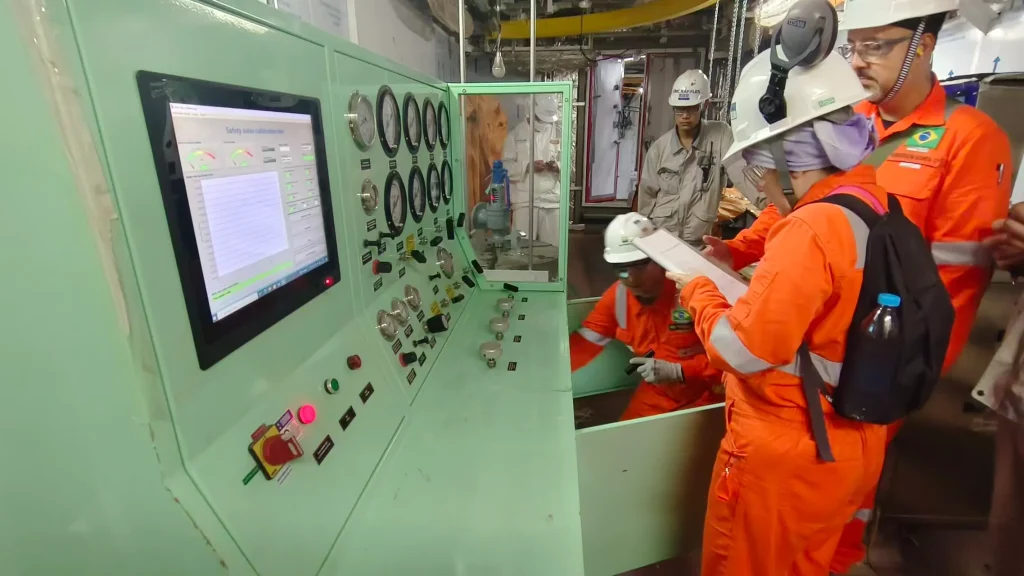
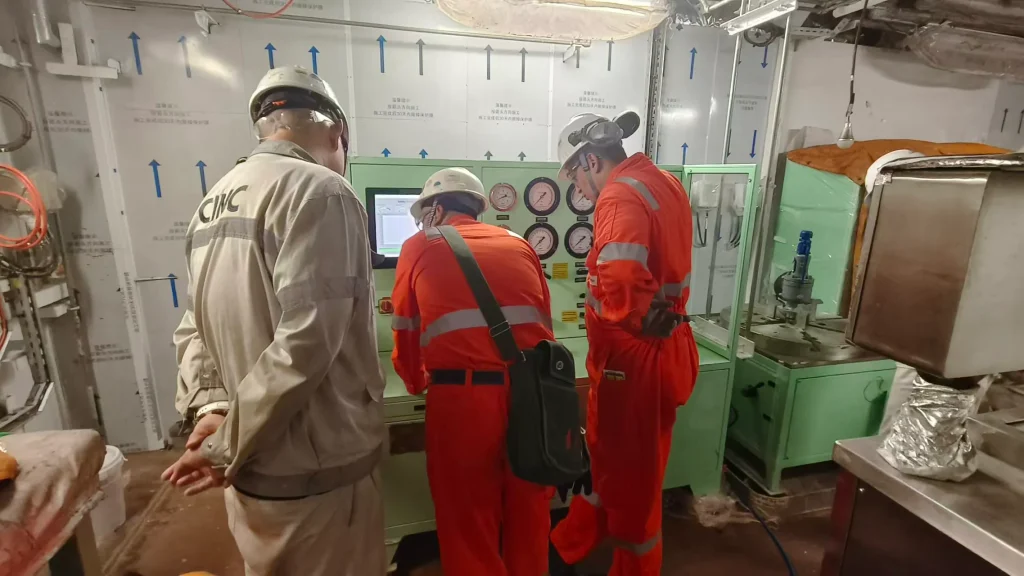
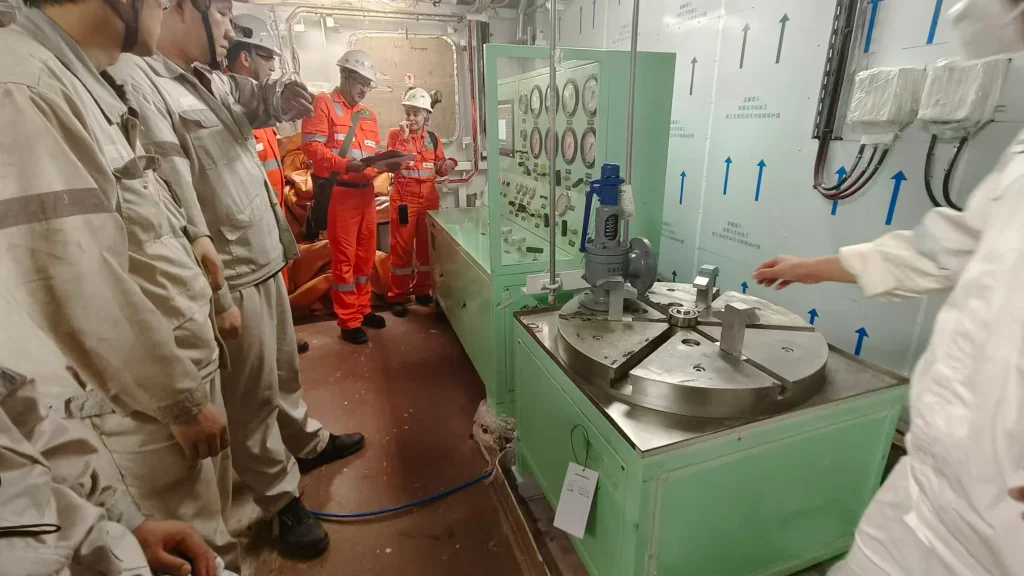
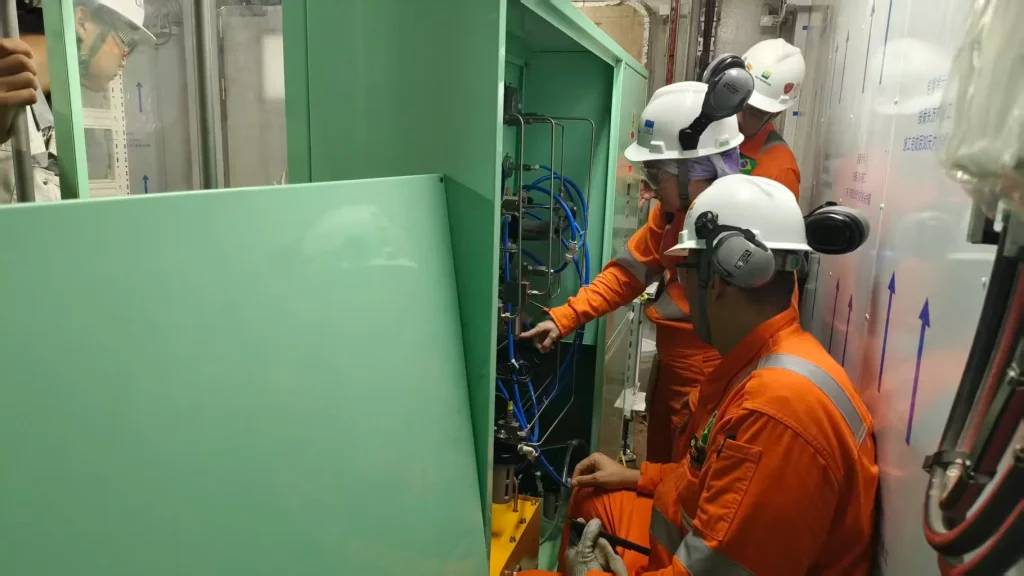
Highlight recently completed the acceptance work for an offline safety valve calibration test bench at Raffles Shipyard. Project personnel reviewed the equipment configuration, operating procedures, control functions, pressure indication, valve clamping, calibration workflow, and routine maintenance requirements.
The completed safety valve test bench will support the shipyard’s inspection and maintenance personnel in carrying out standardized safety valve testing under controlled workshop conditions.
What Was Completed at Raffles Shipyard?
The project involved the on-site acceptance of a dedicated offline safety valve testing and calibration system.
Unlike an online testing system, an offline calibration bench requires the valve to be removed from the protected equipment and installed on a controlled test fixture. The operator can then apply the required test pressure and evaluate the valve under repeatable workshop conditions.
The acceptance work focused on the practical functions needed for daily valve inspection, including:
Equipment appearance and configuration inspection
- Control-panel operation
- Pressure-source verification
- Pressure gauge and instrument checks
- Valve installation and clamping
- Pressure regulation
- Set-pressure testing
- Reseating-pressure observation
- Tightness and leakage inspection
- Pressure release and system reset
- Emergency operating procedures
- Operator training and routine maintenance
The project demonstrates how a properly configured safety valve test bench can help shipyards establish a more organized and repeatable valve-maintenance process.
Highlight’s broader safety valve testing range includes manual, computer-controlled, portable, online, and customized systems for different inspection environments.
Why Do Shipyards Need an Offline Safety Valve Calibration Bench?
Ships and offshore engineering facilities contain pressure systems that may use compressed air, steam, gases, hydraulic media, fuel-related fluids, or other process media. Safety valves are installed to protect these systems against excessive pressure.
During maintenance, a valve may need to be removed for cleaning, repair, inspection, and recalibration. An offline PSV test bench provides a controlled environment in which technicians can evaluate valve performance before the valve is returned to service.
For shipyards, an offline bench can support:
- Planned vessel maintenance
- Offshore platform repair
- Pressure-system overhauls
- Valve workshop operations
- New vessel construction
- Pengoperasian awal peralatan
- Periodic safety inspections
- Repaired-valve verification
- Maintenance documentation
The equipment can also reduce dependence on temporary testing arrangements and help technicians follow a consistent calibration procedure.
What Is an Offline Safety Valve Test Bench?
An offline safety valve test bench is a specialized pressure testing system used to inspect a safety valve after it has been removed from the pipeline, pressure vessel, boiler, compressor, or other protected equipment.
The valve is mounted on a suitable fixture and connected to a controlled pressure source. Pressure is then increased according to the required testing procedure.
Depending on the valve type and project configuration, the system can be used as a:
- Meja uji katup pengaman
- PSV test bench
- Safety relief valve test bench
- Pressure safety valve test bench
- Relief valve test bench
- Pressure relief valve test bench
- PSV calibration test bench
- Safety valve calibration bench
- Bench test safety valve system
- Offline safety valve testing machine
Sorotan bangku uji katup pengaman kontrol manual is designed for set-pressure, reseating-pressure, and tightness testing of direct-loaded and pilot-operated safety valves.
Which Safety Valve Tests Can Be Performed?
The exact test procedure depends on the valve structure, applicable standard, test medium, pressure range, and the shipyard’s inspection requirements.
A professional safety valve testing equipment configuration may support several core checks.
Set-pressure testing
Set pressure is the pressure at which the safety valve begins to open under specified test conditions. The operator gradually increases the pressure while monitoring the valve response.
Accurate set-pressure verification helps determine whether the valve will operate at the intended protection point.
Reseating-pressure testing
After opening, the valve should close again as pressure decreases. Reseating pressure, sometimes described as setback pressure in equipment documentation, is an important indicator of valve performance.
Tightness and sealing testing
The valve seat and sealing surfaces can be checked for unacceptable leakage below the set pressure. A stable test source, suitable measurement instruments, and correct valve installation are important for obtaining repeatable results.
Opening-behavior observation
Depending on the test bench and valve structure, technicians may observe opening response, pressure stability, valve action, and repeatability.
Apa bangku uji katup pengaman kontrol komputer can automate pressurization, sensor monitoring, data recording, and report generation for inspection environments requiring greater traceability.
How Was the Test Bench Evaluated During Acceptance?
Acceptance is not limited to confirming that the equipment can generate pressure. The system must also be practical for the customer’s actual workshop operation.
During an offline safety valve test bench acceptance process, the project team pays attention to the complete testing workflow.
Valve mounting and clamping
The fixture should match the intended valve connection, size, and structure. The valve must be installed securely before pressure is applied.
Interchangeable fixtures may be required when one bench is used for several flange sizes or valve configurations.
Pressure regulation
The pressure source should allow controlled pressure increase, stable pressure holding, and safe depressurization. Sudden or poorly controlled pressurization can make calibration more difficult.
Instrument indication
Pressure gauges, sensors, and digital displays must be suitable for the intended test range. Operators should also understand which instrument is used for clamping pressure, test pressure, inlet pressure, and other system functions.
Operating sequence
The control sequence should be clear to trained personnel. Operators need to understand valve mounting, line selection, pressure application, result observation, pressure release, and fixture removal.
Safety protection
The system should include appropriate operating controls, pressure-release devices, protective structures, warning labels, and emergency procedures according to its configuration.
The test bench includes a centralized control console, multiple pressure instruments, operating valves, and a dedicated valve-clamping station.
What Is the Difference Between an Offline and Online Safety Valve Test Bench?
The main difference is whether the safety valve is removed from the operating system.
Offline safety valve test bench
For offline calibration, the valve is dismantled and taken to a workshop test bench.
This method is suitable when the valve needs:
- Cleaning
- Disassembly
- Seat repair
- Spring adjustment
- Internal inspection
- Complete workshop calibration
- Leakage testing
- Post-repair verification
It provides controlled testing conditions and allows technicians to inspect the valve more thoroughly.
Online safety valve test bench
An bangku uji katup pengaman online evaluates the valve while it remains installed on the pressure system.
Online testing can be useful when removing the valve would require a major shutdown or when the operator needs to verify opening behavior under in-service conditions.
Highlight’s online calibration system is intended for installed safety valves on boilers, pressure vessels, and pressure pipelines, with testing based on controlled supplementary force and valve-response measurement.
Offline and online systems are therefore complementary rather than interchangeable. Shipyards may use offline testing for workshop maintenance and online testing for selected in-service inspection tasks.
Why Is Controlled Pressure Generation Important?
A safety valve calibration bench requires a pressure source that can increase pressure smoothly and maintain stable output near the valve’s set point.
The appropriate pressure-generation method depends on:
- Media uji
- Required test pressure
- Valve size
- Internal volume
- Required pressure-increase rate
- Test frequency
- Workshop air supply
- Cleanliness requirements
- Safety requirements
Depending on the system design, an air-driven gas booster pump may be integrated to provide high-pressure gas for calibration. The test pressure source and clamping pressure source can be designed as independent circuits to improve operating control.
Highlight’s computer-controlled bench design combines pneumatic-hydraulic clamping with air-driven gas and liquid pressure sources for project-dependent safety valve testing.
For projects requiring a dedicated pressure source, customers can also review Highlight’s pompa pendorong gas dan sistem penguat gas options. These systems can be configured according to inlet pressure, target pressure, gas type, required flow, and operating frequency.
What Is the Role of the Valve Test Bench in Shipyard Maintenance?
A safety valve test bench is designed specifically for safety valves and pressure relief devices. A general bangku uji katup serves a different but related purpose.
General valve testing equipment may be used for:
- Gate valves
- Ball valves
- Globe valves
- Check valves
- Butterfly valves
- Industrial isolation valves
Common test items include hydrostatic shell-strength testing, seat sealing, high-pressure sealing, and low-pressure gas-tightness testing.
Industrial buyers may use terms such as:
- Meja uji katup
- Valve bench test
- Valves test bench
- Valve testing machine
- Hydraulic valve test bench
- High pressure valve test bench
- Valve test rig
- Valve test stand
- Leak test bench
Highlight’s valve test bench range supports different clamping structures and test modes for multiple industrial valve types, while the safety valve calibration range focuses on set pressure, reseating pressure, and sealing performance.
For a shipyard maintenance workshop, these two equipment categories can support different valve-inspection tasks without competing for the same function.
How Can Test Results Be Documented?
Test documentation requirements vary according to the customer, valve type, classification requirements, inspection procedure, and control configuration.
A manual safety valve test bench may rely primarily on operator observation and manually completed records. A PLC or computer-controlled system can provide additional data-management functions.
Depending on the selected configuration, a computerized pressure test system may support:
- Real-time pressure display
- Pressure-time curves
- Automatic test sequences
- Test result storage
- Operator identification
- Valve information entry
- Automatic pass/fail judgment
- Calibration report generation
- Historical record retrieval
Customers requiring greater automation can compare manual equipment with Highlight’s computer control safety valve test bench.
The appropriate automation level should be selected according to test volume, documentation requirements, operator workflow, budget, and traceability expectations.
How Should Buyers Select Safety Valve Testing Equipment?
A buyer should not select a safety valve test bench only by comparing maximum pressure or equipment price.
Before requesting a proposal, the buyer should confirm:
- Applicable safety valve types
- Direct-loaded or pilot-operated design
- Minimum and maximum valve size
- Flange or threaded connection
- Maximum set pressure
- Media uji
- Required accuracy
- Expected testing frequency
- Manual or automatic operation
- Data-recording requirements
- Available compressed-air supply
- Installation space
- Workshop environmental conditions
- Applicable testing procedure
- Required fixtures and adapters
A suitable safety valve test bench manufacturer should evaluate these factors before recommending a model.
Highlight provides manual, PLC-controlled, computer-controlled, portable, online, containerized, and project-based safety valve calibration solutions. Customers can also review the company’s detailed safety valve test bench selection guide.
Why Is Customization Important for Shipyard Projects?
Standard equipment can satisfy many routine testing requirements, but shipyard projects may involve specific constraints.
These can include:
- Restricted workshop space
- Existing compressed-air conditions
- Different valve connection standards
- Multiple valve sizes
- Marine maintenance procedures
- Required control-panel layout
- Customer-preferred instruments
- Special documentation
- Local operating habits
- On-site installation limitations
Through its custom pressure testing equipment service, Highlight can evaluate pressure range, flow requirements, test medium, fixture arrangement, control system, port design, installation space, and project-specific functions.
Customization should not mean adding unnecessary complexity. The objective is to provide the functions the operator needs while keeping operation, maintenance, and future support manageable.
What Happens After Equipment Acceptance?
Acceptance marks the completion of an important project stage, but it is not the end of equipment support.
After the safety valve calibration bench enters operation, the customer may require assistance with:
- Operating questions
- Fixture use
- Instrument verification
- Working-medium changes
- Pressure-range adjustments
- Troubleshooting
- Replacement parts
- Preventive maintenance
- Operator retraining
- Control-system support
Sorotan dukungan teknis covers equipment selection, installation guidance, troubleshooting, training, maintenance, and engineering assistance for pressure testing and boosting systems.
The company’s wider industrial equipment service process also includes technical evaluation, project documentation, production support, delivery coordination, installation guidance, and project-dependent field service.
Highlight Continues Supporting Industrial Valve Testing Projects
Highlight will continue developing and supplying safety valve testing equipment, general valve test benches, pressure testing equipment, gas boosting systems, liquid pressure systems, and customized high-pressure testing solutions.
Customers planning a new offline safety valve calibration bench should provide the valve type, valve size, connection method, set-pressure range, test medium, required automation level, testing frequency, applicable procedures, and installation environment.
This information allows the engineering team to evaluate whether a manual control system, computer-controlled bench, portable tester, online calibration system, or customized solution is more suitable.
Contact Highlight to request a technical proposal, safety valve test bench quotation, model recommendation, or customized PSV calibration solution.
 English
 Français
 Русский
 Español
 Português
 العربية
 Tiếng Việt
 한국어
한국어 Bahasa Indonesia
 Deutsch
 Türkçe
 Italiano